
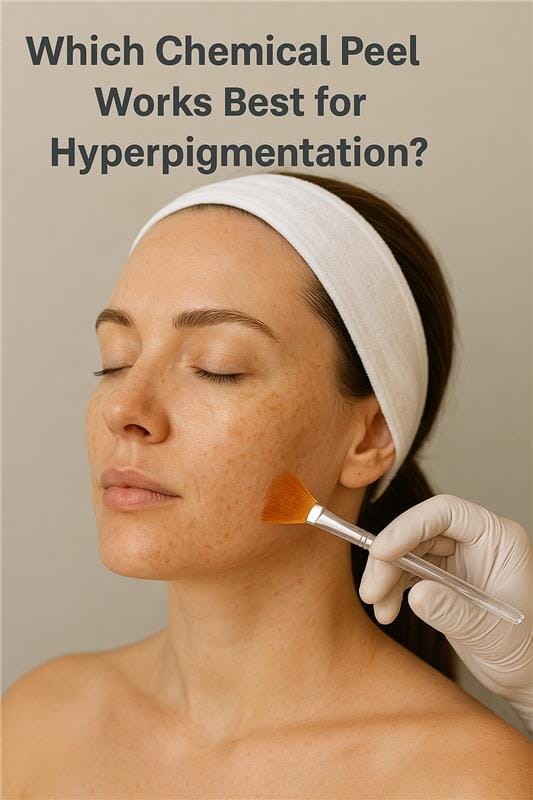
Hyperpigmentation includes the frustration of dark spots, melasma patches, and dull complexion caused by aging, sun tanning, or hormonal fluctuations. The hot climate and other environmental factors in Houston result in pigmentation in a majority of individuals. A chemical peel is the most effective treatment for effectively vanishing pigmentation, but the concern arises: Which chemical peel works best for hyperpigmentation? In this blog, we will provide a complete guide on chemical peels working for hyperpigmentation, and which one will be the most suitable for you!
A chemical peel is a formulated solution that is applied to tanned skin, and it intentionally exfoliates the damaged and pigmented skin cells. The solution is formulated in different consistencies for different skin types, and it is applied for a few minutes, which deeply penetrates the skin and vanishes spots without any pain.
This peel scrubs deeply, attacking damaged and dark-colored skin cells. This exfoliation approach diminishes dark spots and encourages healthy skin.
Chemical peel involves herbal substances that facilitate skin formation and diminish pigmentation over time. Melasma and post-inflammatory freckles can be lessened by substituting pigmented skin cells with new ones.
Peeling optimizes the bloodstream by optimizing oxygen and nutrient flow to the skin. This flow promotes skin healing and enhances overall complexion.
Peels stimulate collagen formation in the skin. Collagen enhances skin texture while inhibiting the production of new pigmented cells.
All chemical peels are formulated to treat hyperpigmentation. The most common ones are
| Type of Peel | Description |
|---|---|
| Glycolic Acid Peels | Glycolic peel, a component of the AHA family and a sugarcane outgrowth, is one of the most frequently used chemical peels. It boosts collagen, encourages skin cell revival, and penetrates well. Ideal for pigmentations that are mild to moderate. |
| Salicylic Acid Peels | Salicylic acid is a water-soluble beta-hydroxy acid (BHA) that works particularly well for skin prone to acne. It’s perfect for post-inflammatory hyperpigmentation since it lessens dark marks left by acne while preventing future flare-ups. |
| Mandelic Acid Peels | Another AHA that works just as well at reducing hyperpigmentation, but is kinder than glycolic acid, is mandelic acid. Because of its gradational action, it’s applicable for people with sensitive skin types and those who are unfit to handle more violent peels. |
| Lactic Acid Peels | A moderate AHA setup in milk is called lactic acid. It’s an excellent option for people with dryness, sensitivity, or mild pigmentations because it not only lightens dark spots but also hydrates the skin. |
| TCA Peels (Trichloroacetic Acid) | Depending on attention, TCA Peels have a medium to deep position of action. They work wonders for deeper male skin, obstinate pigmentation, and sun damage. Compared to superficial peels, the results are more striking, but the recovery period is longer. |
| Cosmelan Peels | A professional-grade peel created especially for melasma and pigmentation is the Cosmelan Peel. In discrepancy to conventional peels, it suppresses melanin formation and encourages skin rejuvenation by combining numerous active substances. It works especially effectively for pigmentation that doesn’t go down with regular peels. |
Enfield Royal Med Spa offers optimal skin rejuvenation treatments, including customized chemical peels, designed to address hyperpigmentation effectively. You don’t have to let hyperpigmentation prevent you from having flawless skin. To find which chemical peel is best for the hyperpigmentation and to begin your path to bright skin, schedule your consultation by filling out the form below.
Let Us Know Where to Send Your Code
Valid once per new client. Expires in 30 day