
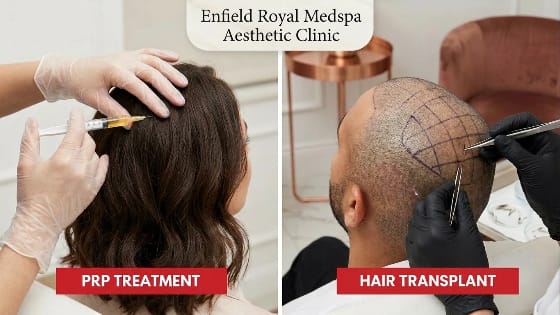
Hair loss is frustrating, particularly when you start researching solutions online. Is a hair transplant the only way to go, or should it be a non-surgical option like PRP hair restoration? With multiple choices, mixed opinions, and tempting offers, you can get confused and not know will any of the treatments will actually bring the desired result to your hair type, loss stage, and lifestyle.
This blog will help you eliminate the confusion by clarifying the difference between PRP hair restoration and hair transplant, their pros and cons, recovery, and the areas of treatment. Reading this will guide you to make an informed choice and take a step towards your hair restoration journey.
PRP (Platelet-Rich Plasma) hair restoration is a non-surgical procedure using the healing factors of one’s own blood to influence hair growth. A minor amount of blood is collected to extract PRP by centrifugation technology, and then injected at specific parts of the scalp to tighten hair follicles, enhance density, and retard hair loss.
A hair transplant is a surgical procedure to replace lost hair by transplanting healthy hair follicles from one part of the scalp (usually the back or sides) to another. More sophisticated procedures, such as FUE (Follicular Unit Extraction), can provide natural-looking, long-term results.
Here is a point-to-point comparison to enable you to estimate which of the two is most appropriate to your requirements:
| PRP Hair Restoration | Hair Transplant |
| A non-surgical procedure where a small amount of blood is drawn, processed, and injected into the scalp to stimulate natural hair growth. | A surgical procedure where healthy hair follicles are extracted from a donor area and grafted into bald or thinning areas. |
| Typically completed within 30–60 minutes per session. | Can take several hours, depending on the number of grafts required. |
| No incisions or stitches involved. | Involves minor incisions and precise graft placement. |
| PRP Hair Restoration | Hair Transplant |
| Minimal downtime; Patients can resume normal activities the same day. | Requires 7–14 days for initial recovery and healing. |
| Mild redness or swelling may occur but subsides quickly. | Scabbing, swelling, and tenderness are common during recovery. |
| PRP Hair Restoration | Hair Transplant |
| Results typically appear gradually over 3–6 months. | Noticeable growth begins in 4–6 months with full results in 9–12 months. |
| Requires multiple sessions for optimal results. | Usually, a one-time procedure with progressive improvement. |
| PRP Hair Restoration | Hair Transplant |
| Not permanent; maintenance sessions are needed every few months. | Permanent solution as transplanted follicles continue to grow naturally. |
| Helps preserve and strengthen existing hair. | Provides long-term coverage in bald areas. |
| PRP Hair Restoration | Hair Transplant |
| Lower upfront cost per session, but multiple sessions increase overall expense. | Higher initial investment, but typically no repeat procedures needed. |
| PRP for hair loss cost varies based on the number of sessions required. | Cost depends on the number of grafts and the complexity of the procedure. |
| PRP Hair Restoration | Hair Transplant |
| Enhances natural hair growth and thickness. | Restores hair in completely bald areas. |
| Improves scalp health and reduces shedding. | One-time solution for significant hair loss. |
| Rejuvenate weak follicles. | Ideal for a dramatic transformation. |
| PRP Hair Restoration | Hair Transplant |
| Early-stage thinning and hair shedding. | Advanced hair loss and receding hairlines. |
| Weak or dormant hair follicles. | Bald patches where hair no longer grows. |
| Preventive care for ongoing hair loss. | Permanent restoration for visible hair gaps. |
| PRP Hair Restoration | Hair Transplant |
| Mild and temporary: redness, swelling, tenderness, minor bruising at injection sites | Surgical: swelling, redness, scabbing, mild bleeding at donor/recipient sites |
| Immediate; mild soreness may last 1–2 days | 7–14 days; requires careful post-op care and avoiding strenuous activity |
| Rare allergic reaction (extremely uncommon) | Temporary hair shedding (“shock loss”) may occur before new growth begins |
The PRP hair restoration and hair transplant are not a universal choice, as the choice varies according to the stage of hair loss, objectives, lifestyle, and cost. Here are a few factors to consider when selecting the treatment to go for:
PRP would have a greater role in younger patients with early thinning, as it stimulates the existing follicles. Hair transplant may be required in elderly patients or those with large bald areas that need to be restored visibly.
PRP is the best solution for mild to moderate hair loss. Hair loss or receding hairlines are complicated issues that might need a hair transplant to be covered permanently.
PRP is more affordable in the short term because it consists of numerous sessions. Hair transplants are comparatively more expensive at first, but generally a one-time procedure with long-term results.
If you are still confused about which solution to go for when restoring hair, you are not the only one. In Enfield Royal Medspa, Tomball, TX, we provide personalized consultations and suggest the best hair restoration treatment according to scalp condition and hair loss stage. Residents of The Woodlands, Cypress, Spring, and Magnolia can easily access the clinic within 10-15 minutes. Book your consultation appointment today at Enfield Royal Medspa in Tomball, and find the solution to your hair restoration.
PRP would be suitable in the initial case of thinning and non-surgical hair fortification, and the hair transplant would give permanent fixation to the bald areas. The superior one will be determined by your level of hair loss and objectives.
No, PRP activates the already existing follicles and delays the loss of hair, although the outcomes are not stable and need to be maintained.
PRP might be the best choice in case of mild thinning or a non-surgical method. Hair transplant is normally advised in case of major baldness or irreversible effects.
Let Us Know Where to Send Your Code
Valid once per new client. Expires in 30 day