
Hair thinning is one of the most widespread but emotionally difficult issues that people experience at an old age. This is not merely an appearance issue to many, but is also related to confidence, identity, and self-esteem. It may be the realization that you have more hair on your pillow, your part line is becoming wider, your hairline is receding in pictures, but either way, it can be a disturbing experience and one that is very personal.
The worst thing about hair loss is the slow pace of its occurrence. This may not be apparent in day-to-day life, but with time, months, or years, the thinning can become noticeable or come in severe form, exposing the scalp or causing large volumes to be lost. To many people, loss of hair may occur abruptly, due to stress, disease, hormonal changes, or nutritional deficiencies. Studies suggest that:
Approximately 50% of men lose their hair by 50 years of age, whereas thinning is evident in almost 40% of women by their middle years.
Stress, lifestyle, and hormonal disproportions are also being reported by the younger adults as causes of hair thinning. This blog gives an in-depth analysis of the causes of hair thinning, clinical treatments available, and how to choose the most appropriate treatment according to your situation. We’ll explore proven solutions from topical treatments to clinical hair therapies and help you determine which approach is right for you
Before settling on any hair loss treatment, it becomes important to find out the reason as to why your hair is thinning in the first place. There is no single cause of hair loss, but it is a symptom that has more than one cause. And every cause reacts to a cure in other ways.
Most individuals commit the failure of rushing immediately into solutions without finding out the underlying problem. This usually results in frustration, money wastage, and procrastination of outcomes. An effective genetic hair loss treatment might be of limited help to shedding induced by stress or an autoimmune disorder. The most widespread reasons for thinning hair and their variation can be broken down.
This is the general reason for hair thinning in the world, and is commonly known as pattern hair loss. It is an affliction in both men and women, but it manifests in different ways in relation to gender.
Causes:
The causes of androgenetic alopecia are mainly:
Genetics (family history is very significant)
Sensitivity to DHT (dihydrotestosterone), a hormone derived from testosterone.
In individuals having this condition, the hair follicles become progressively shrunken because of DHT sensitivity. As time goes on, the follicles will create thinner and shorter hairs until they end the growth of hairs altogether.
How It Appears:
| Men | Women |
|
|
Among the most frequent causes of sudden shedding of hair is telogen effluvium which can be temporary.
What Actually Happens:
Hair grows in cycles as a rule:
In telogen effluvium, many follicles of the hair shift to the shedding stage simultaneously. This causes a visible loss of hair (in many cases, months and weeks after a precipitating event).
Common Triggers
Alopecia areata is an autoimmune disease where the immune system wrongly attacks the hair follicles.
What Actually Happens:
In other instances, hair grows naturally. The condition can recur or advance in others.
Common Triggers
It is not well known, but the cause is possibly due to:
Since it is an immune condition, it can usually be treated medically and not with an over-the-counter remedy. This may also cause loss of hair due to underlying health problems or unhealthy lifestyle habits that interfere with the normal growth of hair.
Diffuse thinning of hair can be a result of both hypothyroidism and hyperthyroidism. The thyroid hormones control metabolism; therefore, an imbalance may interfere with the growth of hair. Once the thyroid is put at par, hair may also improve.
The hair follicles are active in metabolism, and they need proper nutrition to operate. The general shortcomings in relation to hair loss include:
Repeated tension on hair follicles may result in thinning gradually. Common causes are:
The sooner this is handled, the greater will be the probability of regrowth.
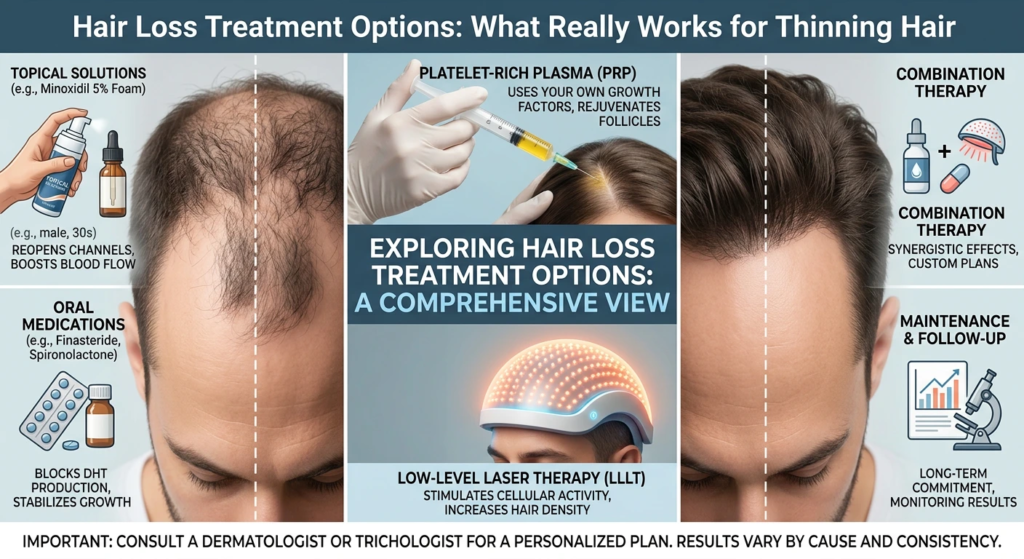
In-clinic therapies may induce deeper biologic repair of the scalp even in those who do not respond as effectively to topical therapies or want a more rapid and more targeted effect. Microneedling with PRP and Low-Level Light Therapy (LLLT) have been regarded as the most popular forms of non-surgical alternatives. The treatments are aimed at stimulating the dormant follicles, getting the scalp healthier, and increasing the effectiveness of the already existing hair growth therapies.
PRP microneedling is a regenerative type of treatment incorporating two potent methods:
This combined action improves natural healing and promotes hair follicle action.
Mechanism of Action
The mechanism of action of this treatment involves several biological mechanisms:
| Micro-Injury Response under Control | Microneedling involves making small holes in the skin with small needles. These micro-injuries:
This condition favors follicle repair and reactivation. |
| Growth Factor Delivery | PRP is composed of a high concentration of platelets that are rich in growth factors, including:
These growth factors:
|
What to Expect in the Treatment:
Typical session steps:
Results Timeline
The regenerative therapies are time-consuming in hair growth. Typical progression is as follow:
| Timeline | What to Expect? |
|---|---|
| 2–4 weeks | Reduced shedding |
| 2–3 months | Early regrowth signs |
| 4-6 months | Density and thickness are enhanced. |
| 6–12 months | Peak visible results |
Downtime
PRP microneedling has low downtime. Ordinary post-therapeutic effects include:
The majority of individuals would go back to normal activities within the same or the following day.
Concerns It Treats
PRP by microneedling is most effective in:
One of its weaknesses is its ineffectiveness in totally bald regions with follicles that are no longer viable.
Low-Level Light Therapy (LLLT) is a non-invasive therapy that involves the usage of red or near-infrared light to cause an activating effect on cellular processes in hair follicles. It is usually administered in:
In contrast to PRP, LLLT does not imply injections and tissue damage.
Mechanism of Action
LLLT operates on a cellular level of energy known as the photobiomodulation.
| Mitochondrial Stimulation | The red light waves (630-680 nm) pass through the body, specifically, the scalp, and are captured by the mitochondria within the cells.
This increases:
|
| Increased Blood Circulation | LLLT enhances the microcirculation in the head by:
The circulation improves healthier longer hair growth cycles. |
| Reduced Inflammation | The presence of chronic inflammation of the scalp helps in miniaturization of the follicles. LLLT exerts anti-inflammatory actions which:
|
| Prolonged Anagen Phase | LLLT will lengthen the active growth period of hair resulting in:
LLLT sessions in the clinic are painless and easy. |
Typical experience:
You are sitting beneath a laser machine or you put on a laser cap. No needles or general anesthesia needed. Denies experiencing any discomfort or feeling of heat. The length of sessions is normally 15-30 minutes.
Results Timeline
The outcomes of LLLT are slow and progressive. Typical expectations:
| 6–8 weeks | Reduced shedding |
| 3–4 months | Early thickening |
| 6 months | Obvious density enhancements |
| 9–12 months | Maximum benefit |
Downtime
LLLT has no downtime. You can:
This is what makes it one of the most convenient clinical therapies.
Concerns It Treats
LLLT works best for:
It is less effective for:
Exosomes are microscopic extracellular vesicles released by stem cells. They contain Growth factors, proteins, and RNA signaling molecules. Instead of infusing stem cells, exosome therapy involves the use of cell messengers that induce regeneration.
Mechanism of Action
| Cellular Communication | Exosomes are biological messengers that signal follicle repair mechanisms and activate dormant stem cells. |
| Anti-Inflammatory Effects | They help:
|
| Angiogenesis Support | Exosomes promote the formation of new blood vessels, which enhances:
|
Why It’s Trending
The exosome therapy is becoming popular due to:
It is not as intrusive as the harvesting of stem cells.
There is no transplantation of living cells.
Faster treatment sessions
Results Timeline
Early indications indicate:
1-2 months: Reduced shedding
4-6 months: Density improvements
Further enhancement as time progresses.
The process of selecting the best treatment for hair loss is not universal. The causes of hair thinning may be of various types, different degrees, and react differently with gender, age, and general health in general. To choose the appropriate method, it is necessary to learn about your hair loss, your medical history, and your personal ambitions.
| Causes | Best Treatment |
| Pattern Hair Loss Androgenetic Alopecia (Pattern Hair Loss) | Minoxidil, finasteride (men), Spironolactone (women), PRP, Hair Transplant. |
| Telogen Effluvium (Shedding Stress-Due to Sickness) | Treatment of the underlying cause, stress management, nutrition, and soft hair care, Minoxidil or LLLT. |
| Alopecia Areata (Autoimmune) | PRP, some topical immunomodulators, and corticosteroid injections. |
| Nutritional or Medical Deficiencies. | Treat deficiency (iron, vitamin D, protein), changes in lifestyle, Minoxidil or LLLT. |
Sick and tired of the same old hairstyle in the mirror? Enfield Royal Medspa in Tomball, TX, is your local place to get the best hair restoration that works. Our methods involve the use of cutting-edge techniques that will help you have thicker and healthier hair.
In The Woodlands, Cypress, Spring, or Magnolia, that is, you are just 10-15 minutes away from professional care that fuses science, accuracy, and customized care- right in your neighborhood.
Schedule your appointment today and get started on your fuller head of hair and confidence.
Let Us Know Where to Send Your Code
Valid once per new client. Expires in 30 day