
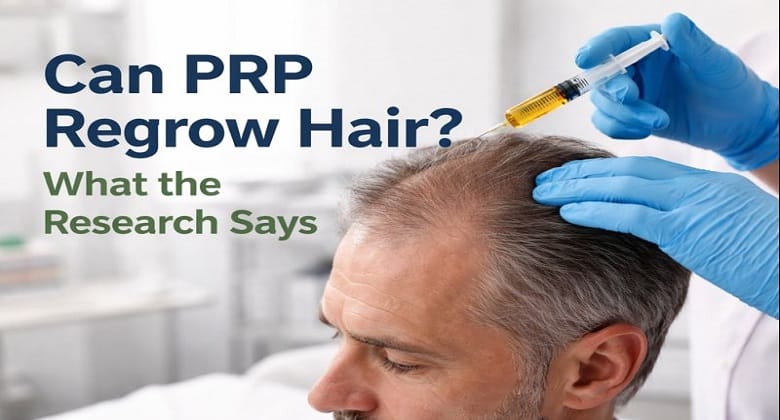
A receding hairline, a thinning crown, or a widening part is not just a cosmetic issue, but can be a source of low self-esteem, lack of confidence, and even depression. It is common to find that many people experience their hair becoming finer with age, shedding excessively, or not regrowing. This can be due to genetics, stress, pregnancy, or hormonal changes. Pattern baldness can start when men are in their 20s, and diffuse thinning can be experienced by women.
Shelves overflowed with shampoos, supplements, and topical treatments that promise a miracle regrowth; it may be hard to know which ones work. This misunderstanding has made many people seek in-office services that are beyond the superficial type of care. Platelet-Rich Plasma (PRP) treatment of hair loss is one of the treatments that has received a lot of attention in recent years.
However, does PRP really stimulate hair growth, or is it just another fad? This blog is a research-based exploration of PRP hair treatment results in Tomball.
Platelet-Rich Plasma (PRP) in Tomball is a concentrated part of your own blood that has a high concentration of platelets and growth factors. Platelets are commonly known due to their clotting ability, but they are also important in repairing and regenerative processes in tissues. The use of PRP therapy in orthopedics, sports medicine, and wound care is not new but the use in dermatology and hair restoration has increased steadily.
As the PRP is injected into the scalp, it transfers a high concentration of biologically active growth factors directly into hair follicles. These are platelet-derived growth factor (PDGF), vascular endothelial growth factor (VEGF), insulin-like growth factor (IGF), and transforming growth factor-beta (TGF- 2 ). As per research, PRP operates in a variety of ways:
Here’s what PRP is considered to be an effective option for:
PRP arouses microscopic follicles targeted by DHT, which contributes to the growth in the density of hair and the thickness of the hair shafts. It works best at the initial or middle stages of patterned loss of hair.
Under the crown and mid-scalp, PRP enhances diffuse thinning through increasing the blood supply to the follicles and extending the period of growth. Research reports that hormonally-thinning women are very satisfied.
PRP may be used to provide strength to the already existing follicles before severe miniaturization. It can be of special use to those patients who may observe that there is more shedding or less hair quantity without bald spots.
PRP promotes quicker follicular restoration following hormonal stabilization in isolated instances. It needs to be applied carefully, after excluding nutritional deficiencies and current telogen effluvium.
The anti-inflammatory and regenerative functions of PRP could improve the results as soon as the inflammatory process is put under control. It is not a major therapy, but it can help in follicle recovery.
Platelet-Rich Plasma (PRP) is not a universal treatment
for all types of hair loss. Its success is very much conditional on the diagnosis behind, the follicles’ health, and the scalp. Clinical-based evidence confirms the use of PRP in non-scarring alopecia, where the follicles of the hair are weakened yet not inactive.
The best evidence of PRP efficacy is high-quality randomized controlled trials (RCTs). Several half-head designs PRP versus saline injections involving multiple double-blind, placebo-controlled studies have been conducted in men with androgenetic alopecia.
Olisova et al. (2023) Meta-analysis on the Efficacy of Platelet-rich Plasma in Patients with Androgenetic Alopecia has proved statistically significant increases in hair density and hair count in the areas treated with PRP in 12 weeks. The average result was an 18 to 22% increase in hair density and more than 30 hairs per cm 2 increase in the number of hairs in treated areas, significantly higher than placebo results.
Besides quantitative gain, the dermoscopic scan showed there was an increase in hair shaft diameter, suggesting robust and thicker growth of hair instead of a mere increase of fine hairs.
In comparison, clinical trials of PRP versus minoxidil and PRP versus combination therapy all showed highest hair regrowth was seen when PRP was used in combination with minoxidil. To compare them with other treatments, combination groups exhibited more than 26 hairs per cm 2 increase in hair density, which was better than either of the treatments alone.
Immunohistochemical findings also demonstrated that cellular proliferation, as seen in the combination therapy group,s is more enhanced, which indicates that the effect is synergistic at the follicular level. This is evidence that PRP is not a panacea, but an adjunct therapy, and this supports using PRP as a valuable and worthwhile therapy.
Nagaja et al. (2024) Comparison of the Efficacy of Two Different Local Anesthesia Techniques for Mesotherapy in Temporal Region Alopecia reviews large datasets of data on 15 or more clinical trials indicate that PRP treatment led to a 28-30 hairs per cm 2 increase in mean hair density after 3-6 months. The level of patient satisfaction is always at the 80-85% mark, which indicates physical changes as well as psychological gains. The side effects were minimal and short in nature, and usually affected only temporary pain, redness, or mild swelling at the injection sites.
In addition to the numerical data, the clinical trials utilized standardized photography and trichoscopy to affirm the observed improvements. These objective assessments demonstrated a lesser amount of scalp visibility, better hair coverage, and enhanced consistency of hair shaft thickness. This visual and quantifiable result combination is a strong argument that PRP will encourage real biological enhancement and not a short-term cosmetic enhancement.
| Study Type | Duration | Sample Size | Mean Hair Density Gain (hairs/cm²) | Patient Satisfaction |
| RCT (Half-head, placebo) | 12 weeks | 30 | +33.2 vs +2.3 (placebo) | 88% |
| RCT (PRP vs Minoxidil) | 3 months | 90 | PRP +16.8; Combo +26.3 | 84% |
| Observational (Microbiota study) | 3 months | 14 | Qualitative improvement | >85% |
| Meta-analysis/Systematic Review | 3–6 months | 15 trials (n≈450) | +28–30 | 80–85% |
| Hair Condition | Typical Number of Sessions | Duration of Results |
| Androgenetic Alopecia (Male Pattern Hair Loss) | 3-4 sessions spaced 4 weeks apart | 9–12 months with maintenance |
| Female Pattern Hair Loss (FPHL) | 3-4 sessions at monthly intervals | 9-12 months |
| Early-Stage Hair Thinning | 2-3 sessions over 2–3 months | 6-9 months, depending on progression and care |
| Postpartum Hair Shedding | 1-2 sessions if indicated | 6-9 months, varies by hormonal normalization |
| Hair Loss with Controlled Scalp Inflammation | 2-3 sessions after inflammation control | 6-9 months, requires ongoing scalp management |
According to the existing clinical evidence, PRP is capable of stimulating significant hair growth and thickening in patients with androgenetic alopecia when injected early and in tandem with some standard treatments such as minoxidil. Although not a cure against baldness, PRP provides a more scientifically credible, minimally invasive approach to hair loss prevention and enhancement of the quality of hair.
Just like any medical intervention, the results are based on the diagnosis, regularity, and expert skills. The information herein is given in learning capacity and is not supposed to substitute what should be done by a qualified health practitioner.
In case you are experiencing progressive thinning, a receding hairline, or loss of hair volume, PRP hair therapy is an ideal option.
Book your PRP appointment today at Enfield Royal Med spa, Tomball to get long, healthy hair in less time.
Let Us Know Where to Send Your Code
Valid once per new client. Expires in 30 day