

With the advancement of technology, Laser tech has evolved, with different wavelength present for all skin types. Diode, Alexandrite, and Nd lasers have different wavelengths and hence different interactions with melanin in the skin and hair. The selection of the right technology can impact the comfort, safety, efficacy, and unwanted pigment changes of the treatment.
This blog discusses 3 wavelengths around 810 nm for the diode, 755 nm for the Alexandrite, and 1064 nm for the Nd. All lasers possess qualities better suited to specific skin tone, hair type, treatment area, and tanning experience. Laser hair removal is not always performed with the same settings for each patient. At Enfield Royal Medspa, Tomball, TX, every laser treatment session is prescribed after the initial consultation with a board-certified physician.
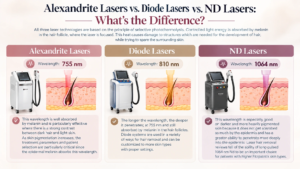
All three Laser technologies are based on the principle of selective photothermolysis. Controlled light energy is absorbed by melanin in the hair follicle, where the laser is focused. This heat causes damage to structures which are needed for the development of hair, while trying to spare the surrounding skin.
Alexandrite Lasers
Wavelength: 755 nm
This wavelength is well absorbed by melanin and is particularly effective where there is a strong contrast between dark hair and light skin. As skin pigmentation increases, the treatment parameters and patient selection are particularly critical since the epidermal melanin absorbs this wavelength.
Diode Lasers
Wavelength: 810 nm
The longer the wavelength, the deeper it penetrates; at 755 nm and still absorbed by melanin in the hair follicles. Diode systems are used in a variety of ways for hair removal and can be customized to more skin types with proper settings.
ND Lasers
Wavelength: 1064 nm
This wavelength is especially good on darker and more heavily pigmented skin because it does not get absorbed as much by the epidermis and has a greater ability to penetrate more deeply into the epidermis. Laser hair removal reviews tell of the ability of long-pulsed 1064 nm Nd to be an important choice for patients with higher Fitzpatrick skin types.
This does not imply that one laser is “better” than the other. Clinical research has shown that alexandrite, diode, and Nd systems can all be used effectively to treat unwanted hair, and the type of system used will depend largely on the patients and parameters used.
Skin tone is one of the most critical factors to consider for laser hair removal, as it uses melanin for the treatment. The laser should heat the hair follicle, rather than the epidermis.
Alexandrite: Suited to Lighter Skin Tone, Dark Hair Color
The 755 nm Alexandrite laser is highly absorbed by melanin and is capable of delivering good follicle heating with high contrast between the hair and skin. It is usually linked to lighter skin tones, especially if the patient has thick, black hair. It could be very effective due to its powerful melanin absorption; however, they need to be used more carefully due to the melanin absorption.
Diode: A Handy Choice for Multiple Skin and Hair Types
The 810 nm diode laser is in the middle range of wavelength between Alexandrite and Nd. It targets the follicles effectively and goes deeper into the skin than shorter-wavelength Alexandrite. The diode laser has been proven for long term hair reduction and has been tested in various skin types with the use of appropriate energy levels. Diode treatment is especially applicable to people with medium skin color and dark coarse hair.
Nd:YAG: Ideal for Darker Skin Shades
The 1064 nm Nd laser is especially useful for patients who have darker skin, because it has a longer wavelength, which means it is absorbed less by the epidermal melanin than shorter wavelengths.
Published reviews prove the need for longer wavelengths and proper treatment parameters with Fitzpatrick skin types IV-VI to minimize complications like hyperpigmentation, hypopigmentation, blistering, and crusting. But just because one has darker skin does not necessarily mean that he or she is suitable for Nd. There are still some factors to be taken into account, including: hair color, hair thickness, treatment area, tanning, previous laser treatments, and individual skin response.
An important factor for all three is that laser hair removal is effective only if there is enough pigment in the hair to absorb the energy of the laser. Blonde, white, gray, and some red hair typically don’t react well because they have less of the desired melanin.
Treatment speed depends on the Laser wavelength. The speed of the appointment depends on the spot size, the duration of the pulse, the number of pulses in a second, the area being treated, the density of hair, and the design of the device. The legs, back, chest, or arms are larger body areas when compared to the upper lip or underarms and take longer. Today’s laser technology also includes larger treatment areas and cooling systems to enhance the comfort and efficiency of treatment.
It feels like a warm snap, or a rubber-banding effect when separate pulses meet the hair follicles. Certain locations may be more sensitive than others. The comfort level will differ from patient to laser system. A comparative study of three laser systems showed that both Alexandrite and diode were equally comfortable for the subjects studied, whereas Nd caused more discomfort. Keep in mind, however, that the findings do not necessarily constitute a ranking and vary greatly depending on the modern device, the cooling technology, the treatment setting, and the individual’s pain sensitivity.
Cooling is particularly important because it protects the epidermis and allows the laser to deliver controlled thermal energy into the follicle. In certain cases, topical numbing medicine is also provided for small and sensitive areas. Laser hair removal generally involves several treatment sessions, regardless of the technology, due to the natural cycle of hair follicles. Even if you use laser technology, more than one session is typically needed to achieve the results of laser hair removal because hair follicles go through anagen, catagen, and telogen stages. Laser therapy is most effective when the hair being treated is at a proper growth stage. The American Academy of Dermatology recognizes that many patients have treatments about every 4-6 weeks, depending on the patient and area of treatment.
| Body Area | Most Suited Laser |
| Face & Upper Lip | Alexandrite / Diode |
| Chin & Jawline | Alexandrite / Diode / Nd: YAG |
| Neck | Diode / Nd: YA G |
| Underarms | Diode / Nd: Y AG |
| Bikini Line | Alexandrite / Diode / Nd: YAG |
| Brazilian Area | Diode / Nd: YAG |
| Legs | Alexandrite / Diode |
| Arms | Alexandrite / Diode |
| Chest | Diode / N d: YAG |
| Back | Diode / Nd: YAG |
| Shoulders | Diode / Nd: YAG |
Shaving every few days causes razor bumps, cuts, and ingrown hairs, whereas waxing is painful and is time taking. Choosing the right laser technology introduces you to the comfort, painless hair removal experience and results.
Laser hair removal is recommended after an initial exam at Enfield Royal Clinic Medspa of Tomball, TX. The procedure used depends on a number of factors, including your skin tone, hair color and thickness, treatment area, medical history, sun exposure, and hair-removal goals. Our Tomball medspa is easily accessible to many residents, being only a 10-15-minute drive from patients in Tomball, Magnolia, The Woodlands, and Spring, TX. Book your Laser Hair Removal appointment today and eliminate shaving and waxing from your life.
Which type of laser is better for hair removal, Diode or Alexandrite?
The Diode (810 nm) and Alexandrite (755 nm) lasers are effective in providing long-term hair reduction. Alexandrite is especially effective on lighter skin tones and darker, coarser hair; Diode is a good choice in a wider variety of skin tones. You should take your skin type, hair color, and the provider’s experience all into consideration.
Who should not get Laser Hair Removal?
Laser hair removal needs to be postponed if you have an active skin infection, open or irritated skin, or a recent tan. Some drugs or diseases that sensitize the skin or inhibit healing need to be considered. The laser is designed to target pigment in the hair, so those with very light, gray, or white hair may not see much benefit.
Is the YAG laser better than the Alexandrite laser?
Neither is superior; however, the type of laser varies based on hair color and skin tones. Alexandrite is very effective for lighter skin tones, and the longer-wavelength Nd: YAG (1064 nm) is typically better suited for darker or more pigmented skin, as it can decrease the amount of epidermal melanin absorbed. Laser tech, settings, and an experienced physician are all-important for safety.
How long will my laser hair removal last?
Many patients have less hair regrowth after a series of treatments, and if regrowth does occur, it is usually less prominent and thinner. Most people require repeated treatment, and maintenance treatments may be necessary as the hair grows back, says the American Academy of Dermatology. The results will be different depending on the treatment area, hormones, hair type, skin type, and the type of laser.