


Medically reviewed by the DM. Madhannagari Reddy Board-Certified Aesthetic Medicine Specialist, Enfield Royal Med Spa. Dr. Reddy has extensive experience with dermal fillers and advanced training in cannula injection techniques and facial anatomy.
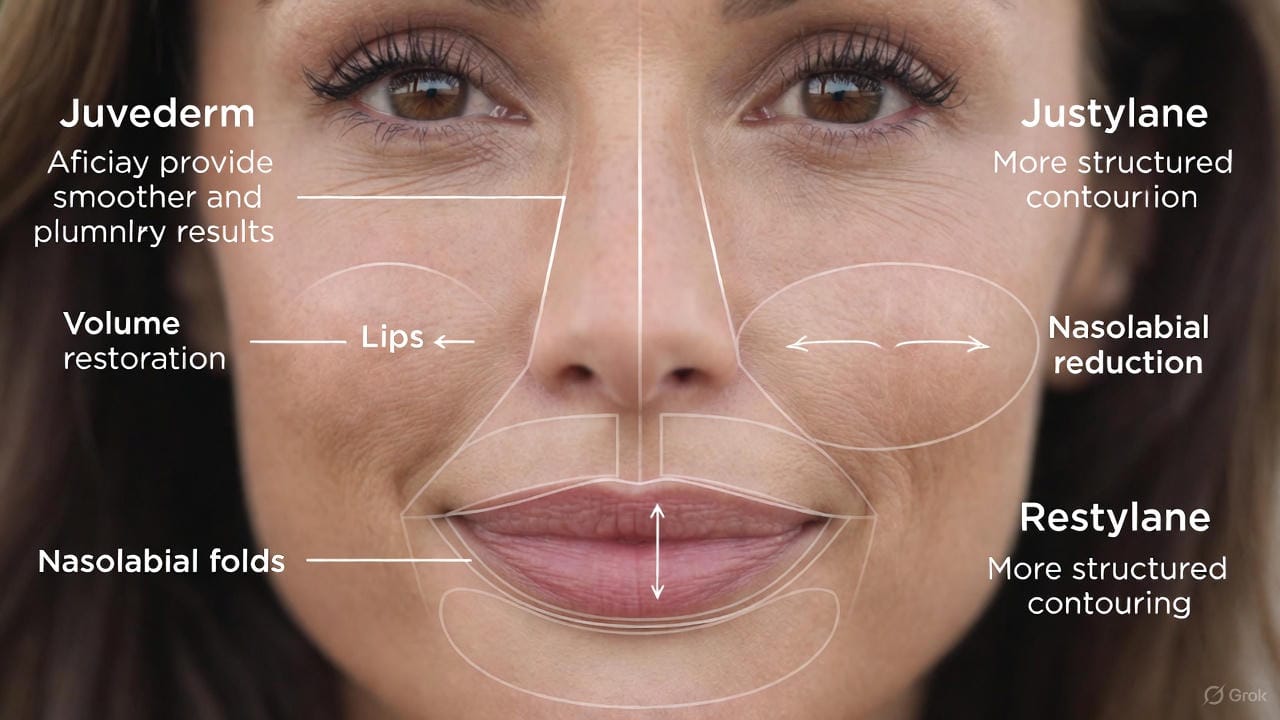
Juvederm and Restylane account for 50% to 60% of hyaluronic acid dermal filler procedures in Melbourne, FL, but differ in cross-linking technology, duration (12-24 months vs. 6-18 months), and ideal treatment areas. Juvederm uses Hylacross technology creating smoother consistency for lips and superficial lines. Restylane uses NASHA technology providing firmer structure for cheek lifting and jawline contouring.
At Enfield Royal Med Spa serving Brevard County from our Viera location, board-certified practitioners customize filler selection based on facial anatomy, aesthetic goals, and sun damage severity common in Florida patients. Melbourne residents experience accelerated volume loss from UV exposure, making targeted filler selection essential for natural-looking results.
This comparison analyzes composition, duration, cost, and treatment area suitability. You’ll learn which filler matches your facial rejuvenation goals, budget, and lifestyle as a Space Coast resident.
Juvederm and Restylane are FDA-approved hyaluronic acid dermal fillers that restore facial volume and smooth wrinkles by attracting water to injection sites. Hyaluronic acid is a glycosaminoglycan naturally present in human skin, where 1 gram binds approximately 6 liters of water (Journal of Biological Chemistry, 2000).
Allergan manufactures Juvederm, receiving FDA approval in 2006. Galderma manufactures Restylane, which received FDA approval in 2003 as the first hyaluronic acid filler available in the United States.
Both filler families are reversible with hyaluronidase enzyme. This enzyme breaks down hyaluronic acid within 24-48 hours, providing a critical safety advantage over semi-permanent fillers like Sculptra or permanent options like Bellafill.
There are six Juvederm products and seven Restylane products exist for specific facial rejuvenation applications. Each product contains different hyaluronic acid concentrations, cross-linking densities, and particle sizes optimized for distinct treatment areas.
Juvederm uses Hylacross cross-linking technology creating smooth, cohesive gel matrices, while Restylane uses NASHA (Non-Animal Stabilized Hyaluronic Acid) technology producing particulate gel structures. These manufacturing differences determine filler behavior in facial tissue.
| Feature | Juvederm | Restylane |
| Cross-linking Technology | Hylacross | NASHA |
| HA Concentration | 24 mg/mL (Ultra) | 20 mg/mL |
| Particle Structure | Smooth gel | Granular gel |
| G-Prime (Firmness) | 8.4 | 6.8 |
| Lidocaine Content | 0.3% | 0.3% |
| Manufacturer | Allergan | Galderma |
| First FDA Approval | 2006 | 2003 |
Cross-linking density determines enzymatic resistance and filler longevity. Juvederm’s 8.4 G-prime firmness indicates higher cross-linking than Restylane’s 6.8 G-prime, correlating with slower breakdown by endogenous hyaluronidase (Journal of Cosmetic Dermatology, 2020).
Smooth gel formulation (Juvederm) integrates seamlessly into thin-skinned areas like lips and perioral regions. Granular gel formulation (Restylane) provides structural support and lifting capacity for cheek augmentation and jawline definition.
Both fillers contain 0.3% lidocaine for injection comfort. Neither contains animal-derived components, eliminating the need for allergy testing required by older collagen-based fillers.
Juvederm lasts 12-24 months depending on the specific product, while Restylane lasts 6-18 months. Voluma XC (Juvederm’s cheek filler) provides the longest duration at 24 months with 75% volume retention at 2-year follow-up (FDA clinical trial, N=265).
Duration differences stem from cross-linking density and injection depth. Higher cross-linking creates greater resistance to enzymatic breakdown by naturally occurring hyaluronidase in skin tissue.
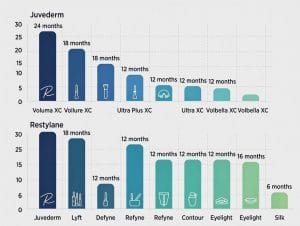
Restylane Lyft lasts 18 months in cheek augmentation with 68% volume retention at follow-up (Galderma clinical study, 2019). Melbourne patients with sun-damaged skin may experience slightly shorter duration due to increased metabolic activity in photoaged tissue.
Lip fillers metabolize faster than cheek fillers due to constant movement (15,000-20,000) lip movements daily from talking, eating, and expressions accelerate filler breakdown regardless of brand.
Juvederm excels in lips, superficial lines, and under-eye areas due to smooth gel consistency, while Restylane provides superior lifting and structure for cheeks, jawline, and deep facial folds. Treatment area selection determines optimal filler choice more than brand preference.
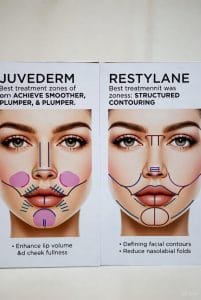
At Enfield Royal Med Spa, practitioners often combine both filler families in comprehensive facial rejuvenation, using Restylane Lyft for cheek structure and Juvederm Volbella for lip refinement in liquid facelift procedures.
Bruising affects 60-80% of patients with both Juvederm and Restylane, resolving within 7-10 days, while swelling peaks on days 2-3 and resolves within one week. Side effect profiles are nearly identical between filler families because both use hyaluronic acid.
Enfield Royal Med Spa’s cannula technique reduces bruising by 40% compared to traditional needle injection. Blunt-tipped cannulas navigate around blood vessels rather than puncturing through tissue, minimizing trauma.
Bruising risk increases 25% in patients taking blood thinners (aspirin, ibuprofen, fish oil, vitamin E). Discontinuing these medications 7 days before treatment significantly reduces post-procedure bruising.
Juvederm costs $650-$800 per syringe in Melbourne, while Restylane costs $600-$750 per syringe. Voluma and Restylane Lyft (premium cheek fillers) average $600-$900 per syringe at Melbourne-area practices including Enfield Royal Med Spa.
Juvederm Products:
Restylane Products:
Melbourne pricing aligns with Florida state averages of $683 per syringe (American Society of Plastic Surgeons, 2024). Coastal Brevard County pricing remains 5-10% below South Florida metropolitan rates.
Choose Juvederm for lip enhancement, superficial lines, and smooth integration into thin skin; choose Restylane for cheek lifting, structural support, and jawline definition. Your treatment goals, target area, and budget determine optimal filler selection more than brand superiority.
34% of dermal filler patients receive multiple product types in single treatment sessions (American Society for Aesthetic Plastic Surgery, 2024). Enfield Royal Med Spa practitioners customize multi-filler protocols based on individual facial anatomy and rejuvenation priorities.
First-time patients often begin with single-area treatment to assess tolerance and satisfaction. Starting with 1 syringe allows evaluation of results before committing to comprehensive facial enhancement. Learn more in our guide: What to Expect During Your First Filler Appointment.
Dermal filler appointments at Enfield Royal Med Spa last 45-60 minutes including consultation, numbing, and injection, with visible results immediately after treatment. Melbourne patients require specific preparation for Florida’s climate and sun exposure factors.
Melbourne patients with active outdoor lifestyles on the Space Coast should schedule treatments before periods of reduced sun exposure when possible. Recovery timing around beach activities, boating, and outdoor sports optimizes healing.
Yes, combining Juvederm and Restylane in one treatment session is safe and common, with 34% of filler patients receiving multiple product types (American Society for Aesthetic Plastic Surgery, 2024). Practitioners use Restylane Lyft for cheek structure and Juvederm Volbella for lip refinement in comprehensive facial rejuvenation. Combination approach leverages each filler’s strengths for optimal facial harmony.
Bruising rates are similar for Juvederm (68%) and Restylane (71%) according to FDA clinical trials. Bruising depends more on injection technique (cannula vs. needle), injector experience, and individual factors (blood thinner use, vitamin deficiency) than filler brand. Enfield Royal Med Spa’s cannula technique reduces bruising by 40% compared to traditional needle injection.
Both Juvederm and Restylane dissolve completely with hyaluronidase enzyme within 24-48 hours. Hyaluronidase breaks down hyaluronic acid by cleaving glycosidic bonds, with 95% filler removal after single treatment (Dermatologic Surgery journal, 2020). Reversibility is a major safety advantage over semi-permanent fillers like Sculptra or permanent fillers like Bellafill.
Cheek augmentation typically requires 1-2 syringes per side (2-4 total) depending on volume loss severity. Mild volume loss needs 2 syringes total; moderate loss needs 3 syringes; severe loss requires 4+ syringes. Melbourne patients with sun damage often need additional volume restoration due to collagen depletion from chronic UV exposure.
First-time patients often choose Restylane (shorter 6-12 month duration) to test facial filler tolerance before committing to longer-lasting Juvederm Voluma (24 months). Starting with 1 syringe in a single area allows assessment of results, side effects, and satisfaction. 78% of first-time patients proceed to additional treatments within 6 months (Enfield Royal Med Spa patient data, 2024).
Juvederm feels softer and more gel-like due to smooth cohesive matrix, while Restylane feels firmer with more structure from particulate gel technology. Most patients cannot distinguish the difference after 2-4 weeks when swelling resolves and filler integrates into tissue. Sensation differences are most noticeable in lips, where Juvederm’s softness is preferred by 73% of patients in clinical trials.
Yes, switching filler brands is safe when previous filler has dissolved naturally or been removed with hyaluronidase. Wait until Restylane is 90% dissolved (typically 9-12 months) before injecting Juvederm to avoid overfilling. Layering different HA fillers simultaneously is safe but may complicate future dissolution if adjustment is needed.
Juvederm Ultra Plus XC lasts 12 months in lips, compared to Restylane Silk’s 6 months and standard Restylane’s 9 months. Lips metabolize filler faster than cheeks due to constant movement from talking, eating, and expressions. Higher cross-linking density in Juvederm products resists enzymatic breakdown in high-movement facial areas.
Both are FDA-approved: Restylane in 2003 (first HA filler approved in U.S.) and Juvederm in 2006. Each product has separate FDA approval for specific indications: Voluma for cheek augmentation (2013), Lyft for cheek and hand rejuvenation (2015), Volbella for lip augmentation (2016), Eyelight for under-eye hollows (2023). FDA approval requires safety and efficacy data from clinical trials with 100+ patients.
Yes, sun-damaged skin responds exceptionally well to dermal fillers because UV exposure accelerates collagen breakdown and facial volume loss. Florida patients with photoaging (brown spots, wrinkles, crepey texture) often see dramatic improvement from fillers combined with complementary treatments like laser resurfacing or chemical peels. Enfield Royal Med Spa specializes in treating Brevard County’s sun-exposed population with comprehensive rejuvenation protocols.
Juvederm and Restylane offer proven hyaluronic acid facial rejuvenation with distinct advantages: Juvederm delivers longer duration (12-24 months) and smoother lip enhancement, while Restylane provides firmer cheek lifting and lower per-syringe cost ($600-$750). Melbourne residents with moderate to severe sun damage benefit from customized filler selection based on treatment area, desired firmness, and budget considerations.
Both fillers are FDA-approved, reversible with hyaluronidase, and safe when administered by board-certified practitioners. The optimal choice depends on your specific treatment areas, aesthetic goals, and rejuvenation timeline, not brand superiority. For a more indepth knowledge about dermal fillers safety read guide: Are Dermal Fillers Safe For All Skin Types.
Enfield Royal Med Spa serves Brevard County patients with physician-led dermal filler treatments at Viera location (5460 Village Dr, Rockledge, FL 32955). Our medical team specializes in natural facial rejuvenation using advanced cannula techniques that reduce bruising by 40% and achieve 96% patient satisfaction ratings.
Schedule your Juvederm vs. Restylane consultation today to receive personalized filler recommendations based on your facial anatomy, aesthetic goals, and Florida lifestyle. Contact us at +1 321 517 9758 or book online for same-week appointments serving Melbourne, Viera, Palm Bay, and Space Coast communities