

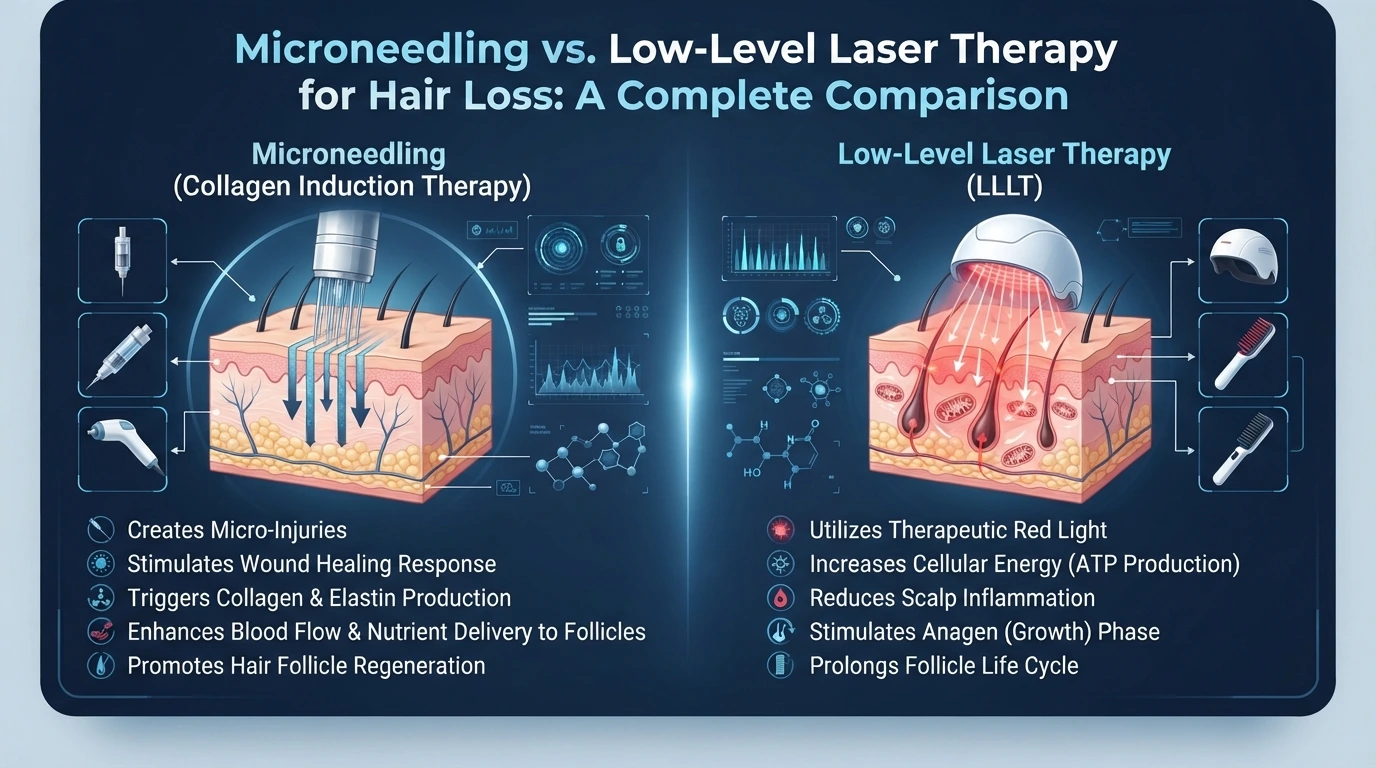
Hair loss may happen to anyone at any moment, irrespective of gender or age, owing to numerous factors including hormonal imbalances, medical issues, nutritional deficiencies, stress, and ageing. There are two new treatments for some who are experiencing pattern hair loss: microneedling and low-level laser therapy (LLLT). There are some objectives that both techniques aim to accomplish when it comes to growing hair; however, they are completely different from each other. Consult your physician about the right technique that will suit you best.
Microneedling is a highly minimally invasive technique, where the device with a very fine needle creates micro-wounds in the scalp. The tiny holes stimulate the body’s natural wound healing process. The process activates activity around hair follicles and helps to release growth factors. Also, microneedling is beneficial for the scalp area and has been studied as a treatment for androgenetic alopecia (male pattern hair loss). Treatment is typically performed by a trained individual using a device and technique appropriate for the scalp. Microneedling can be utilized as a standalone procedure or in conjunction with other hair loss treatments, depending on the person’s condition and treatment plan.
Low-level laser therapy (LLLT) is a form of treatment which is called photobiomodulation that simply uses low-intensity light on the scalp, without any invasive procedures. LLLT is not a procedure that requires the skin to be incised as microneedling does. It utilizes the principle that light stimulates the cells in the scalp and hair follicles, ensuring cell function and the growth of the hair.
The LLLT is administered by a professional or with a home-use device. This treatment has no downtime. However, from a general perspective, there certainly is a requirement for uniformity because hair growth is a rather slow process.
The primary difference is because of the interaction of the scalp with the treatment. Microneedling creates micro-injuries which activate the body’s repair mechanism. LLLT is the delivery of light without rips, tears, or skin damage.
| Factor | Microneedling | Low-Level Laser Therapy (LLLT) |
| Composition | Uses fine needles to create controlled micro-injuries in the scalp. | Uses low-intensity light to stimulate hair follicles. |
| How it works | Stimulates the scalp’s healing response and growth-factor activity. | Influences cellular activity in hair follicles and supports the hair-growth cycle. |
| Invasiveness | Minimally invasive | Non-invasive |
| Downtime | Temporary redness, tenderness, or scalp sensitivity. | No downtime |
| Maintenance | Maintenance sessions are recommended depending on individual response and treatment goals. | Ongoing treatments are required to maintain benefits. |
| Temporary side effects | Redness, mild swelling, tenderness, or irritation | Mild warmth, temporary scalp discomfort, or irritation |
No one treatment is best for everyone experiencing hair loss. Treatment depends on the cause and pattern of hair loss, scalp condition, medical history, treatment goals, and more.
Some people prefer microneedling as an alternative to surgical hair transplant, which involves incisions and scars. Microneedling has proven effective alongside hair-loss therapies.
LLLT is an ideal option for individuals seeking a non-surgical procedure that fits into an extended hair-care regimen. Some light-based devices are approved for certain hair loss treatments, but they have different results for different people. A professional evaluation is used to find out if either of them is suitable for your particular hair loss condition.
Selecting based on ‘convenience’ or ‘popularity’ is not the most important issue to consider; rather, consider the following factors:
Particularly important to make a proper diagnosis, since treatments intended for pattern hair loss may not be able to treat other causes of hair loss.
Any treatment option takes time to show results, and hair growth does not occur overnight. Hair follicles follow their natural growth cycle, so results take time and patience. Multiple treatment sessions are required for microneedling. A few patients experience changes over a few months. Whereas LLLT needs to be used regularly. Use of home-use devices is generally recommended as per your physician’s instructions. Results are shown gradually. Treatment duration differs significantly from one person to another, and no treatment provides a specific number of hair regrowths.
Sometimes two or more hair-loss treatments are combined in treatment. Microneedling and LLLT have two different mechanisms of action, and your physician decides which combination is best for their patient based on the patient’s condition and overall treatment plan. But it can’t be assumed that treatments should be given together for everyone. Only a professional can evaluate the scalp, figure out the probable cause of hair loss, and decide if it would be beneficial to use multiple treatments. Depending on the diagnosis, other proven hair loss remedies might also be taken into account.
The skin is broken during the microneedling process, and it is important to have the correct technique, sterilization, and aftercare procedures. Signs of irritation, swelling, tenderness,or pinpoint bleeding occur temporarily. LLLT is usually safe and does not cause any serious side effects, although mild scalp irritation or discomfort may occur. The light-based device quality and specifications varies, so it’s important to follow professional or manufacturer directions. Include any medical conditions or medications, scalp issues, and prior hair-loss treatments before starting either of the treatments.
Enfield Royal Clinic helps you understand your options for hair thinning or hair loss, including microneedling and low-level laser therapy. During a personalized consultation, our board-certified physicians identify your hair loss concerns and determine which treatment method best fits your needs. Take the next step to a customized hair restoration plan by calling Enfield Royal Clinic in Branchburg, NJ today for a consultation.
Getting Here From Nearby Communities
| Community | Approx. Distance | Drive Time | Main Route |
| Bridgewater | ~7 miles | 7 to 14 min | US-22 / US-202 |
| Somerville | ~7 miles | 5 to 12 min | Route 28 |
| Raritan | ~6 miles | 6 to 12 min | US-202 |
| Hillsborough | ~11 miles | 5 to 18 min | US-206 |
| Manville | ~11 miles | 5 to 20 min | US-22 / Route 28 |
Nowadays, a proven light-based therapy for hereditary/androgenetic hair loss is low-level light therapy (LLLT), also known as low-level laser therapy or photobiomodulation. FDA-approved LLLT devices have demonstrated benefits in hair density and thickness with regular use, but some individuals do not benefit from them.
There is no definitive answer. The best treatment depends on the individual. LLLT has more evidence as a physical treatment on its own, whereas microneedling seems to be a more promising adjunctive therapy with other treatments, like minoxidil.
Should I get laser or microneedling first?
The correct order differs depending on the hair loss type and cause. LLLT is done as a regular, continuous treatment, while microneedling is frequently applied as an adjunct treatment instead of another tried-and-tested medical treatment. Your physician prescribes the best approach and combination for you.
Yes, LLLT can cause some regrowth, especially in individuals suffering from androgenetic alopecia. There have been clinical improvements in hair density and thickness, but this is slow to happen, and not all people will benefit. Treatment is usually required to be consistent to sustain benefits.



Let Us Know Where to Send Your Code
Valid once per new client. Expires in 30 day