


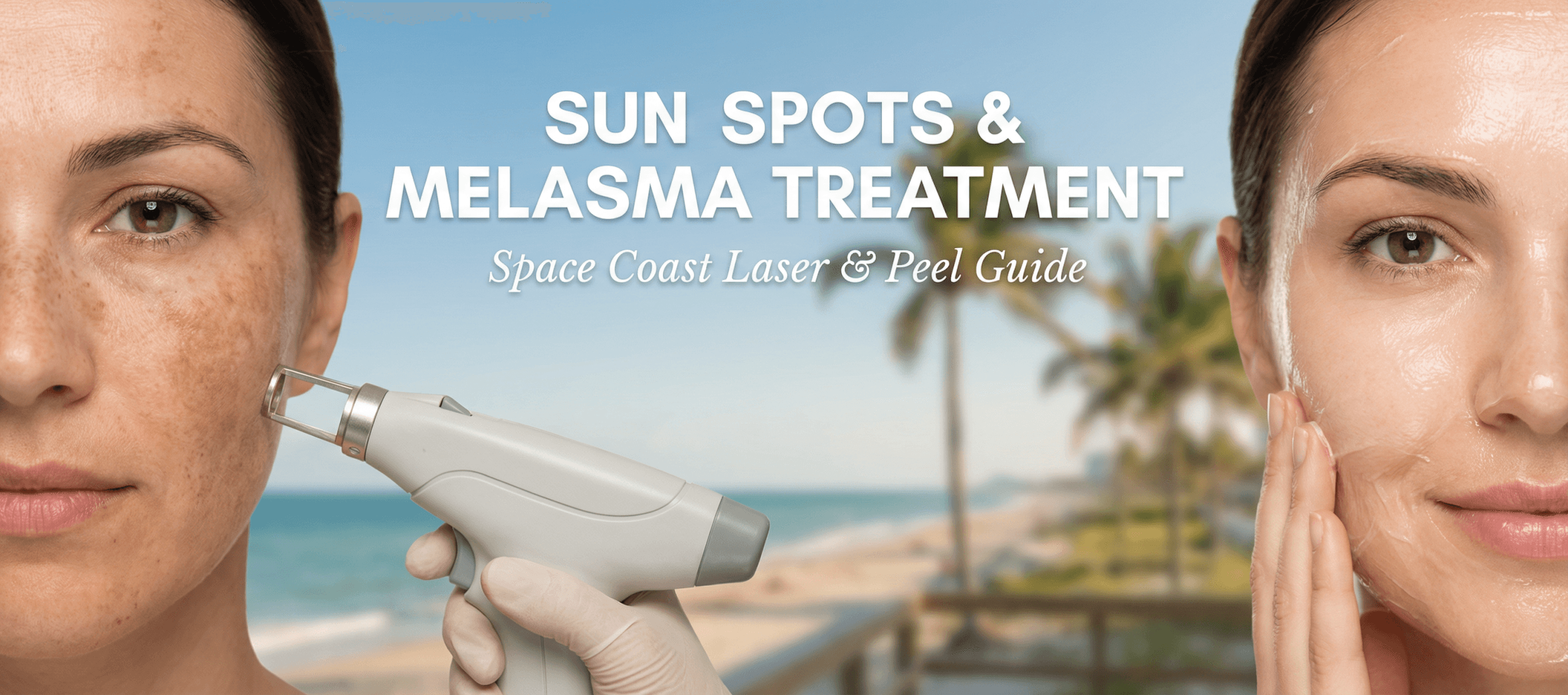
Florida’s UV index averages 8–11 from March through October. Northern states hover between 3 and 6 during those same months. This difference accelerates melanin production by 25–40 %, triggering visible pigmentation years earlier than national averages. Brevard County residents experience constant solar exposure that compounds with humidity, creating conditions where sun spots and melasma develop faster and resist standard treatments.
Sun spots—clinically termed solar lentigines—result from cumulative UV damage to melanocytes. Melasma involves a different mechanism: hormonal fluctuation combined with UV exposure triggers patchy, symmetric hyperpigmentation across cheeks, forehead, and upper lip. Both conditions share UV as a catalyst, yet they require distinct treatment approaches. Our Space Coast climate and skin health guide details how regional factors shape every skin condition we treat.
Melanocytes in Brevard County skin operate under chronic UV stress that never fully relents. Florida UV remains elevated year-round, and melanocytes respond by overproducing melanin as a protective measure. Clinical studies in dermatologic photobiology show melanin synthesis rises approximately 30 % when UV index reaches 10—a reading we record 180+ days annually on the Space Coast.
Heat compounds this effect. Elevated skin temperature increases tyrosinase enzyme activity, the catalyst for melanin production. We often see Melbourne surfers with freckling along goggle lines before May arrives. Viera golfers develop asymmetric sun spots on their left forearms—the side exposed through car windows during commutes. These patterns reflect how regional habits intersect with climate to create predictable pigmentation maps.
Melasma presents differently. Hormonal factors prime the melanocytes, and Florida UV activates them repeatedly. Women taking oral contraceptives or experiencing pregnancy in Brevard County show melasma onset 2–3 years earlier than patients in temperate zones. The condition resists treatment precisely because the triggering environment never pauses.
Treatment timing determines success rates more than treatment selection. November through February offers the safest intervention window. UV index drops to 4–6 during these months. Post-procedure skin faces less rebound activation. Healing occurs with reduced sweat interference.
Humidity affects recovery directly. Brevard’s average 75 % relative humidity during summer creates occlusive conditions on healing skin. Sweat pools under bandages. Bacterial colonization increases. Chemical peel patients treated in July require 40 % more antimicrobial interventions than those treated in December. We schedule deeper interventions during cooler months for this reason.
Still, geography within Brevard creates microclimate variations. Rockledge residents living along the Indian River experience reflected UV that intensifies exposure near temples and cheekbones. Water reflection adds 10–25 % UV load depending on angle and time of day. We observe higher melasma density on the river-facing side of patients who walk the waterfront trails. This data shapes how we counsel timing and protection.
Chemical peels remain first-line treatments for surface-level pigmentation. Formulation, depth, and post-care determine outcomes in humid climates.
Glycolic acid at 30–40 % concentration and salicylic acid at 2 % address superficial sun spots without significant downtime. These peels work within the epidermis, loosening melanin-laden keratinocytes over 3–5 days. Citric acid peels at 20–30 % offer enzymatic action suited to humid conditions because they produce less tissue dehydration. Patients return to normal activities within 24–48 hours. Visible brightening emerges by week 2.
Trichloroacetic acid at 15–25 % reaches the papillary dermis, addressing pigment deposits that superficial peels cannot touch. Jessner solution, a combination of salicylic acid, lactic acid, and resorcinol, prepares skin for deeper TCA penetration. Downtime spans 3–5 days with visible peeling. Lightening becomes apparent by week 3, with full results at week 6.
Viera patients plan these procedures between winter outdoor events. A January peel allows healing before spring golf tournaments. This practical scheduling reflects how we integrate treatment with regional lifestyle patterns.
Healing skin in Florida requires aggressive UV defense. SPF 50 mineral sunscreen needs reapplication every 2 hours during outdoor exposure. Antioxidant masks containing vitamin C and niacinamide reduce post-inflammatory hyperpigmentation risk by 15–20 %. Hydrating serums prevent the transepidermal water loss that humidity paradoxically worsens through sweat-induced barrier disruption.
Lasers offer precision that chemical peels cannot match. They target melanin at specific depths without disrupting surrounding tissue. Yet in practice, laser selection and parameter adjustment for Florida patients differs from protocols used in lower-UV regions.
Fractional 1550 nm lasers create microscopic treatment zones that stimulate collagen while fragmenting melanin deposits. The 1927 nm wavelength targets superficial pigment more selectively. Both avoid full-surface ablation, reducing downtime to 2–3 days of mild redness. We measure average clearance rates of 20–25 % per session, with most patients requiring 3–4 sessions spaced 4 weeks apart.
These devices excel for melasma because they avoid the thermal injury that triggers rebound hyperpigmentation. Low fluence settings—typically 10–15 mJ—provide gradual improvement without inflammatory spikes.
Q-switched lasers deliver nanosecond pulses that shatter melanin particles. Picosecond lasers operate 100 times faster, creating photomechanical rather than photothermal effects. This speed reduces heat damage and lowers post-inflammatory hyperpigmentation risk to 3–5 % in properly selected patients.
Melbourne beachgoers with isolated sun spots respond well to targeted picosecond treatment. Single lesions often clear in 1–2 sessions. Larger areas require staged treatment over 2–3 months. The technology suits Fitzpatrick skin types I–IV with appropriate parameter adjustment.
Complex cases benefit from alternating peel and laser stages. A superficial peel addresses epidermal pigment. while a fractional laser reaches dermal melanin deposits. This layered approach achieves 40–50 % improvement over 6 months—higher than either modality alone. Treatment gaps of 3–4 weeks allow barrier recovery between interventions.
Light-based protocols explored through light-based protocols used by our Viera team follow these sequencing principles, adapting intensity to each patient’s UV exposure history.
Clearing pigment represents half the challenge. Preventing recurrence under persistent Florida UV requires permanent behavioral modification.
Hydrating antioxidant serums containing vitamin C 15–20 %, vitamin E, and ferulic acid neutralize free radicals generated during UV exposure. Zinc-based SPF 50+ sunscreens provide physical blocking without the chemical absorption that can irritate post-procedure skin. UV-protective hats with 3-inch brims reduce facial UV exposure by 50 %.
Monthly maintenance peels using low-concentration glycolic acid (15–20 %) prevent melanin re-accumulation. LED therapy at 630–660 nm wavelengths modulates melanocyte activity without thermal stress. Rockledge boaters retain even tone longer after switching to non-oil sunblock formulas that resist sweat wash off during water activities.
Let Us Know Where to Send Your Code
Valid once per new client. Expires in 30 day