


 Skip to content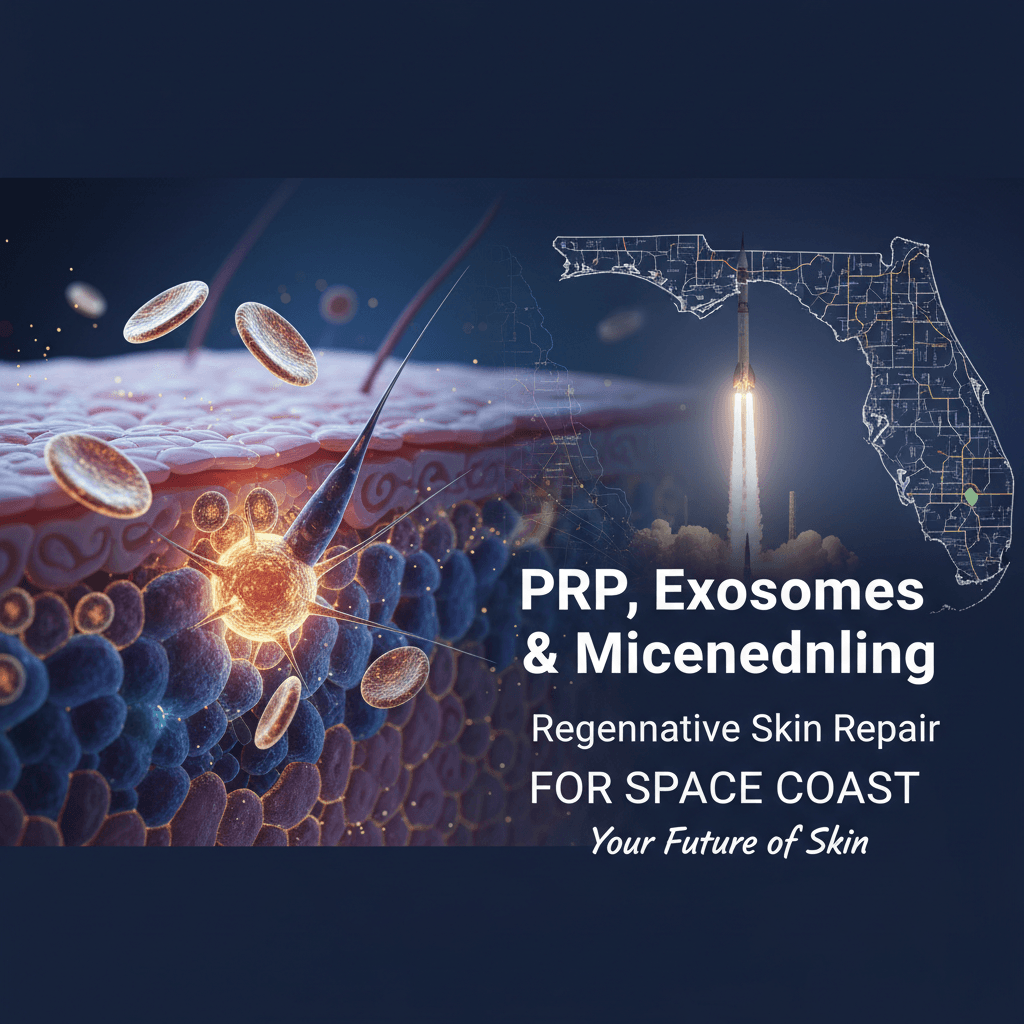
Living on Florida’s Space Coast means exposure to UV index values of 8–11 for much of the year—nearly double what residents in northern states experience. This sustained radiation, combined with 75–85 % ambient humidity, salt‑laden air, and temperatures that regularly exceed 90 °F, accelerates collagen degradation and weakens the skin’s barrier faster than most skincare routines compensate for. Climate‑damaged skin presents as fine lines, uneven tone, rough texture, and a loss of firmness that creams alone rarely reverse.
Regenerative dermatology offers a different path. Therapies like platelet‑rich plasma, exosomes, and microneedling rebuild what UV and heat erode by triggering the skin’s own repair mechanisms. These treatments stimulate fibroblast activity, deliver growth factors directly into the dermis, and accelerate collagen Types I and III synthesis. For readers exploring the connection between environment and skin aging, our Space Coast climate and skin health guide provides the foundational context.
Florida’s climate initiates structural damage at the cellular level through three overlapping pathways. UV radiation fragments collagen fibers and triggers matrix metalloproteinase activity, which degrades existing collagen faster than fibroblasts replace it. Oxidative stress compounds this breakdown by depleting antioxidant reserves in the epidermis and dermis. Salt air—common near the Indian River Lagoon and along Cocoa Beach—strips lipids from the stratum corneum, leaving the barrier permeable and reactive.
Clinical data show UV exposure reduces collagen density by approximately 25–40 % in outdoor workers over a 10‑year span. We observe this pattern frequently. Melbourne surfers often present with early perioral texture loss by age 35, a decade ahead of inland peers with similar genetic profiles. Rockledge boat captains show wind‑driven cheek roughness and capillary visibility that correlates directly with cumulative sun hours. These are not cosmetic concerns alone—they reflect measurable dermal thinning.
Microneedling triggers a controlled wound‑healing cascade that activates dormant fibroblasts. Tiny needles—ranging from 0.5 mm for superficial texture issues to 2.0 mm for deeper scarring or laxity—create micro‑channels in the epidermis and dermis. The body interprets these channels as injury and responds with platelet aggregation, growth factor release, and new collagen deposition over the following 8–12 weeks.
Depth selection matters. Superficial passes at 0.5–1.0 mm address fine lines and barrier texture. Mid‑dermal depths of 1.5–2.0 mm target photoaging‑related elastin loss and moderate atrophy. Treatment intervals of 4–6 weeks allow full collagen remodeling between sessions. Yet in practice, scheduling around Florida’s UV intensity changes outcomes. Viera patients often schedule evening sessions after the UV index drops below 5, reducing the post‑procedure photosensitivity window. Many patients discover these treatments after working through our Brevard County acne and breakout treatment pathways.
Platelet‑rich plasma concentrates the body’s own growth factors—PDGF, VEGF, EGF, and TGF‑β—into a serum applied immediately after microneedling. These proteins trigger angiogenesis, accelerate fibroblast migration, and promote collagen Type III synthesis, which later converts to stronger Type I collagen.
Clinical data indicate PRP‑enhanced microneedling produces approximately 30 % faster epithelial healing and 20 % higher collagen density compared to microneedling alone. This advantage becomes clinically relevant in Florida’s humidity. High moisture levels delay epidermal closure by roughly 6 hours on average; PRP offsets this delay by concentrating wound‑healing signals at the treatment site. Patients report less prolonged redness and faster return to normal activity.
Exosomes deliver intercellular communication that PRP does not fully replicate. These nano‑sized vesicles carry messenger RNA, microRNA, and signaling proteins from stem cells directly into target fibroblasts. Where PRP initiates repair, exosomes modulate the repair quality—promoting organized collagen architecture rather than disorganized scar‑like tissue.
Early clinical findings show 17–20 % improvement in skin elasticity when exosomes augment PRP protocols, compared to PRP alone. For Space Coast patients, this translates to faster recovery and reduced post‑inflammatory hyperpigmentation risk—a concern in sun‑exposed skin prone to melanocyte overactivity. Our Rockledge patients working outdoors report less “after‑heat” redness when PRP is augmented with exosomes. We measure lower erythema scores at 48‑hour follow‑up in these combined protocols.
Sequencing follows a predictable structure adjusted for regional UV patterns. A core series of three sessions, spaced one month apart, establishes the regenerative foundation. Each session builds on the fibroblast activation and collagen synthesis initiated by the previous treatment. Maintenance sessions every six months sustain results and counteract ongoing environmental exposure.
Seasonal planning improves outcomes. UV intensity peaks from April through September on the Space Coast, so we schedule intensive protocols during October through March when daily UV averages drop below 6. Winter is the preferred window for multi‑modality pairing—combining PRP microneedling with fractional laser or light‑based resurfacing. Still, patients with occupational sun exposure benefit from exosome augmentation year‑round to manage inflammation between sessions.
Visible texture improvement appears at approximately four weeks post‑treatment. Collagen re‑densification—measured through ultrasound or clinical assessment—reaches measurable levels at 12–16 weeks. Full results from a three‑session series last 12–18 months, depending on sun exposure habits and home care adherence.
Home support includes antioxidant serums containing vitamin C and E, SPF 50+ reapplied every two hours during outdoor activity, and hydration exceeding 2 liters daily to support dermal water content. Patients avoid direct outdoor work for 24 hours post‑treatment to limit UV‑triggered inflammation. We observe erythema duration averaging 36 hours ± 8 hours in humidity above 70 %, slightly longer than in drier climates. Even so, most patients return to normal routines within 48 hours.
Regenerative intervention becomes essential when photoaging reaches Grade 2–3 severity: visible dermal atrophy, static wrinkling, UV spots exceeding 1 cm, and tactile roughness that resists topical treatment. These signs indicate collagen loss and barrier dysfunction beyond what home care reverses.
Brevard County residents have structured options based on location and need. Viera clinic protocols for PRP microneedling address early‑to‑moderate photoaging with growth‑factor amplification. Rockledge skin programs combining PRP and exosomes target patients with higher inflammatory response or outdoor occupations. For deeper textural concerns, laser support systems provide ablative or non‑ablative resurfacing. Barrier refinement through Melbourne chemical peel formulas complements regenerative work by smoothing superficial damage and enhancing product penetration.
Climate‑adaptive regeneration follows a repeating cycle: UV damage accumulates, regenerative treatment reverses structural loss, and maintenance protocols preserve gains. This loop, managed through seasonal timing and data‑driven assessment, sustains skin health in an environment that otherwise accelerates aging by 10–15 years compared to temperate regions.
The goal is not perfection—it is resilience. Fibroblast density, collagen architecture, and barrier integrity respond to consistent intervention timed around Florida’s environmental rhythms. Readers exploring these methods can browse the clinic’s Florida treatment directory for a complete overview of system‑based care options designed for Space Coast conditions.
Let Us Know Where to Send Your Code
Valid once per new client. Expires in 30 day