


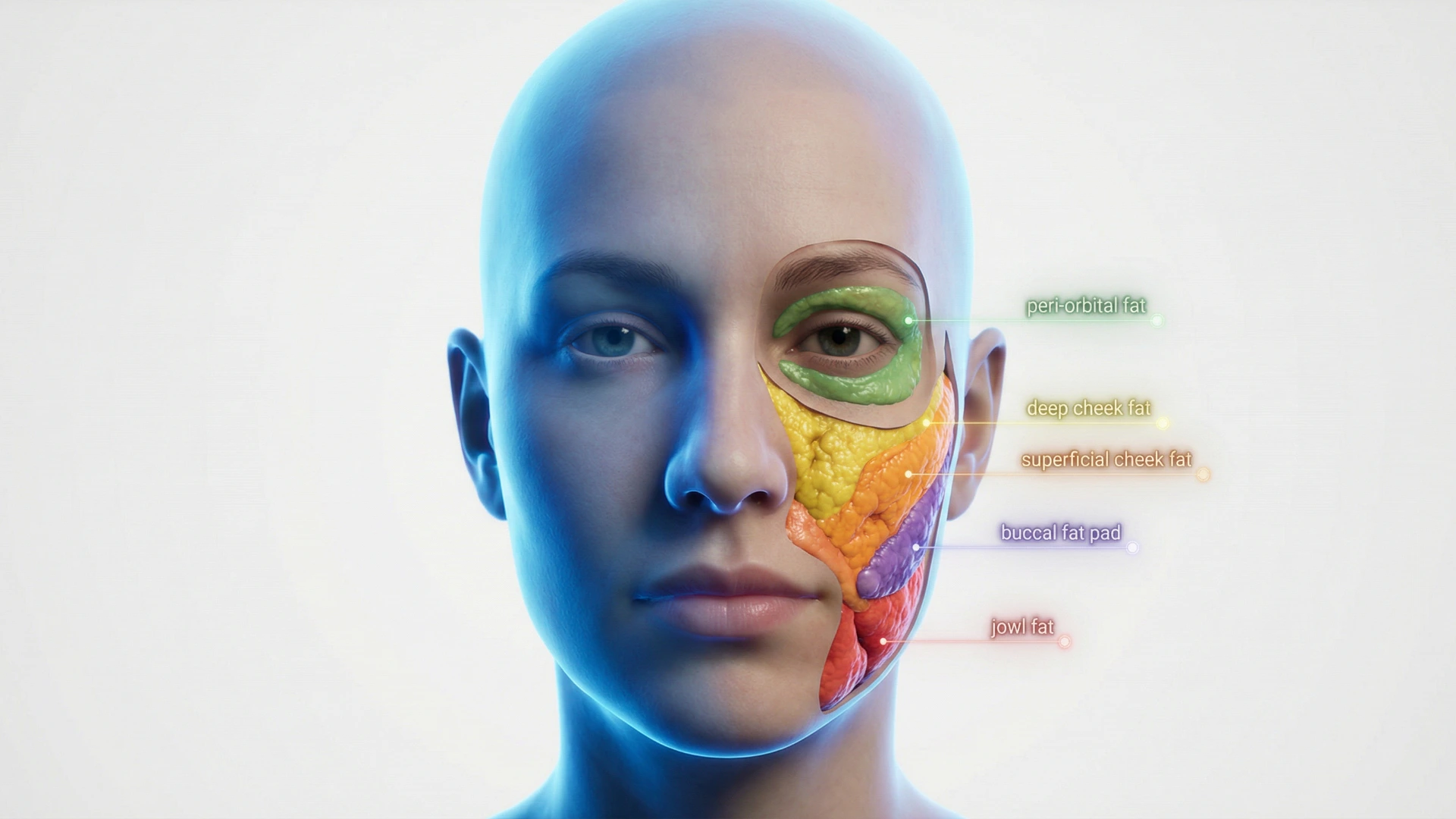
When most people think about aging skin, they picture wrinkles, the fine lines etched by decades of sun exposure, expression, and time. But wrinkles are only one chapter of a far more complex story. Beneath the surface of every youthful face lies an intricate, three-dimensional architecture of fat compartments that silently sculpts your cheekbones, softens your jawline, and frames your eyes. As we age, this hidden map quietly redraws itself, and understanding how is the key to truly effective, natural-looking rejuvenation — the kind of anatomically guided approach we follow at Enfield Royal Medspa.
The face is not filled with a single, uniform layer of fat. Rather, it is partitioned into distinct anatomical compartments — each with its own blood supply, fibrous boundaries, and critically, its own aging timeline. Pioneering cadaveric studies by Rohrich and Pessa (2007) published in Plastic and Reconstructive Surgery first mapped these compartments systematically, fundamentally changing how dermatologists and plastic surgeons think about facial aging.
In broad terms, facial fat is divided into superficial and deep compartments, separated by the superficial musculoaponeurotic system (SMAS) — a fibromuscular layer that serves as a key structural anchor.
The major superficial compartments include:
The deep compartments include:
What makes this anatomy so fascinating — and clinically relevant — is that these compartments do not age uniformly. Each has a distinct biological behavior.
A common misconception is that aging faces simply “deflate,” like a balloon slowly losing air. The science tells a more nuanced story. Volume loss is compartment-specific, directional, and temporally staggered.
Research by Gierloff et al. (2012) using MRI-based volumetric analysis demonstrated that the deep medial cheek fat undergoes the most significant volume reduction with age, while the nasolabial fat compartment may actually increase in volume in some individuals — paradoxically contributing to deepening nasolabial folds not by filling them, but by losing the supporting structure beneath them. When the floor beneath a mound collapses, the mound descends — this is a gravitational and structural phenomenon as much as a volumetric one.
Similarly, deflation of the sub-orbicularis oculi fat leads to descent of the malar (cheek) complex and the characteristic “tear trough” deformity — the shadowed groove beneath the lower eyelid that can make patients appear chronically fatigued. This is not primarily a skin problem; it is a loss of deep structural volume.
In the temporal region, fat atrophy creates the characteristic hollow temples seen in older faces — a subtle but powerful aging signal that dramatically alters overall facial shape, shifting it from the full, heart-shaped or oval contour of youth toward a more rectangular, skeletal appearance.
Volume loss does not act in isolation. Facial fat compartments are tethered in place by osteocutaneous and musculocutaneous retaining ligaments — fibrous structures that anchor skin and soft tissue to underlying bone. Key ligaments include the zygomatic, masseteric, and mandibular ligaments, as well as the orbicularis retaining ligament around the eye.
With time and ultraviolet exposure, these ligaments weaken and elongate. This allows fat compartments — particularly the superficial ones — to ptose (descend) along predictable vectors. The result is the jowl formation along the jawline, the deepening nasolabial fold, and descent of the midface. The volume hasn’t simply disappeared; it has migrated downward, creating heaviness in the lower face while the mid and upper face appears hollowed.
Understanding facial fat pad anatomy has transformed the approach to aesthetic rejuvenation. Treatments that address only the surface — laser resurfacing, topical retinoids, or even superficial filler placement — cannot fully restore youthful architecture when the deficit is deep and structural.
Modern volumetric restoration focuses on layered, anatomically-targeted replenishment. By restoring deep compartment volume first — particularly the deep medial cheek fat and deep SOOF — clinicians re-establish the structural foundation, which in turn lifts overlying soft tissue naturally and reduces the amount of superficial correction needed. This approach minimizes the risk of the overfilled, “pillow face” appearance that results from indiscriminate, non-anatomical filler placement.
When performed with precision, volumetric rejuvenation works with your anatomy rather than against it — restoring the spatial relationships between compartments that defined your youthful face, not simply adding bulk.
Your face ages in a deeply specific, anatomically governed way. The hollowing of your temples, the flattening of your cheeks, the formation of your jowls — each traces back to volume changes in discrete fat compartments that follow their own schedules and obey their own rules. Recognizing this hidden map is the foundation of any meaningful conversation about facial rejuvenation.
Before any treatment, a thorough clinical assessment that evaluates which compartments have been most affected — and whether the primary issue is volume loss, ligamentous laxity, or both — is essential. Science has given us the map. The art lies in reading it correctly.
Let Us Know Where to Send Your Code
Valid once per new client. Expires in 30 day