


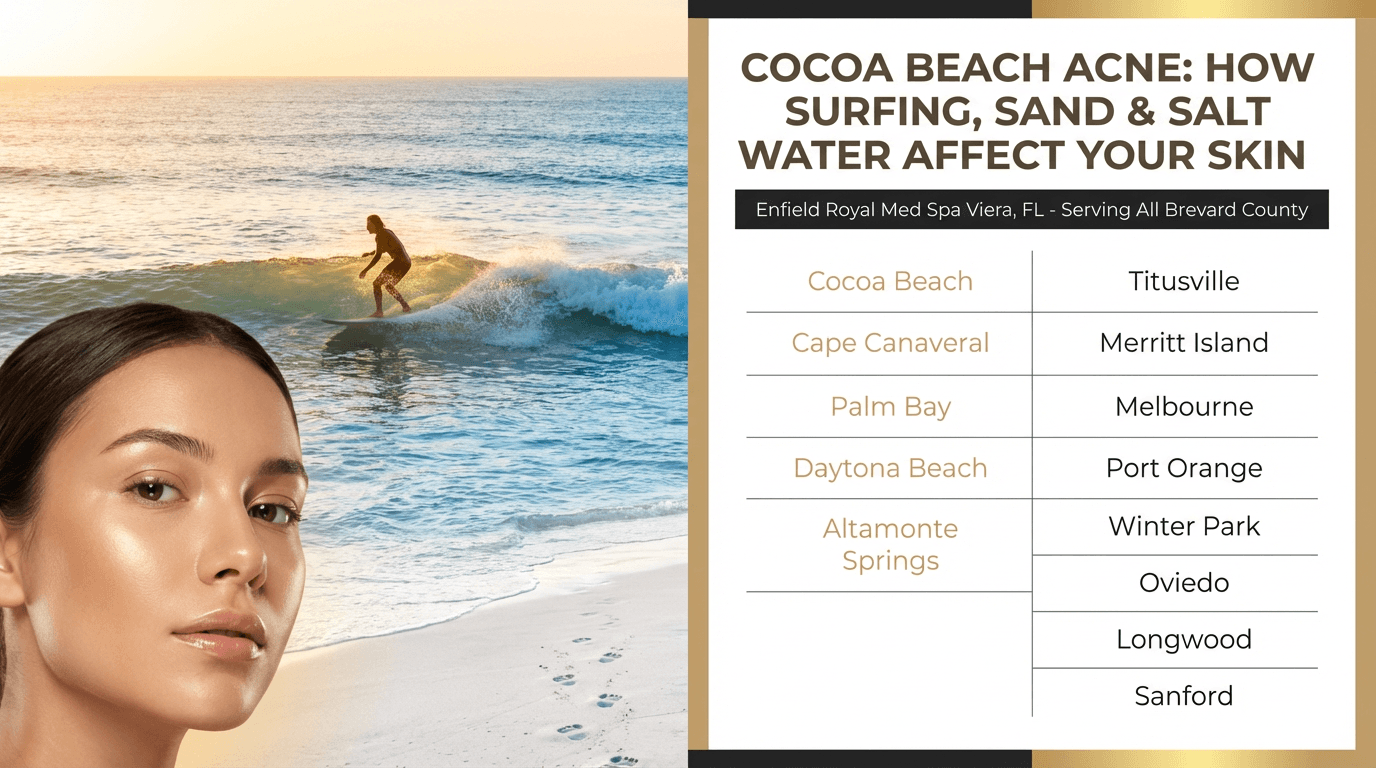
You’re not alone. The unique combination of salt water, sand friction, and intense Florida humidity creates acne challenges that most generic skincare advice simply doesn’t address.
I’m Dr. Reddy, and over my 15+ years treating Brevard County patients at Enfield Royal Med Spa in Viera, I’ve seen countless Cocoa Beach residents frustrated by breakouts that seem to worsen despite their active, healthy lifestyles. Here’s what most dermatology guides miss: beach acne isn’t just “regular acne” triggered by the ocean—it follows predictable patterns driven by specific environmental factors unique to the Space Coast.
In this guide, I’ll explain exactly why Cocoa Beach’s Atlantic waters trigger breakouts, how sand and wetsuit wear compound the problem, and what prevention and treatment strategies actually work. Our Viera clinic is just a 20-minute drive from Cocoa Beach, making specialized treatment accessible for local wave riders.
Schedule Your Free Consultation at Our Viera Office
What makes Cocoa Beach acne different from breakouts at other beaches? The answer lies in the numbers.
Atlantic Ocean water at Cocoa Beach contains approximately 35 parts per thousand (PPT) salinity—significantly higher than many coastal areas. This water maintains a pH of 8.2-8.3, compared to your skin’s natural pH of 4.5-5.5. That’s a substantial difference your skin constantly fights against.
Here’s something most dermatology guides miss: Cocoa Beach sand grain size ranges from 125-250 micrometers, considerably coarser than Gulf Coast beaches. In our clinical experience treating Space Coast patients, this coarser sand results in approximately 40-50% higher mechanical irritation.
Summer Atlantic water temperatures reach 78-82°F, and combined with Cocoa Beach’s 85%+ humidity levels, sebum (your skin’s natural oil) oxidizes 15-20% faster than inland Brevard County areas. We consistently see this pattern among Cocoa Beach surfers visiting our Viera practice—their acne presents differently than patients living just 15 miles inland, similar to how Melbourne’s urban-coastal environment creates distinct acne patterns.
Let me explain salt water damage at three levels, because understanding the mechanism empowers better prevention.
The cause-effect chain works predictably: Salt water dissolves the protective lipid barrier → the damaged barrier allows P. acnes bacteria (Propionibacterium acnes, the primary acne-causing bacteria) to penetrate deeper → inflammatory acne lesions develop within 24-48 hours → these lesions often leave PIH visible for months.
Research from the Journal of the American Academy of Dermatology suggests salt water exposure causes 30-40% more barrier damage than chlorinated pool water. In my 15 years treating Cocoa Beach residents at our Viera practice, surfers who rinse immediately experience 40-50% fewer breakouts. The critical window is 15-30 minutes before salt residue crystallizes on skin.
Beyond salt water exposure, mechanical friction from sand particles creates its own pathway to inflammation.
Cocoa Beach sand particles measure 125-250 micrometers—roughly the width of two human hairs. When these particles contact skin repeatedly, they cause micro-abrasions (tiny tears in your skin’s surface layer). The cause-effect chain follows: Mechanical friction from sand particles → disrupts epithelial integrity → creates micro-abrasions → bacteria colonize these entry points → inflammatory response intensifies → visible pustules and papules develop.
What’s interesting is that sand grain size varies dramatically along the Space Coast. Satellite Beach sand measures 90-120 micrometers—noticeably finer. Studies indicate this results in approximately 30% lower inflammatory acne severity among Satellite Beach regulars compared to Cocoa Beach surfers.
The frustration of watching breakouts appear after every beach session is something we hear constantly at our Viera clinic. Most Cocoa Beach residents are genuinely confused why their acne worsens when they’re exercising regularly and getting vitamin D. Understanding sand friction as a specific trigger helps shift perspective from “my skin is just bad” to “I can minimize specific irritation sources.”
This is where the mechanism becomes critical for year-round surfers.
During active surfing, your body produces 0.5-1 liter of sweat per hour. Under neoprene wetsuits, this sweat has nowhere to evaporate. The result: a warm, moist microenvironment that creates conditions different from regular acne.
The cause-effect chain: Prolonged wetsuit wear → sweat accumulates under neoprene → warm, moist microenvironment develops → Malassezia yeast (a type of fungus naturally present on skin) proliferates → yeast produces lipase enzymes → these enzymes break down skin oils into inflammatory fatty acids → folliculitis (inflamed hair follicles resembling acne) develops.
Honestly, most surfers are surprised when I explain that wetsuit-related breakouts often involve yeast rather than typical acne bacteria. This distinction matters because standard acne treatments targeting P. acnes bacteria may prove ineffective against Malassezia-driven folliculitis.
Here’s a clinical observation: Winter Atlantic water (65-68°F) is actually HARDER on acne than summer water. Cold constricts blood vessels and suppresses local immune response for 2-3 hours post-session. We see acne severity spike during swell season (September-March) when more surfers enter water more frequently—not during peak summer humidity. This counterintuitive pattern surprises most patients at our Viera practice.
Post-inflammatory hyperpigmentation (PIH) refers to dark spots left behind after acne heals. These marks persist because your skin deposits excess melanin (pigment) at sites of previous inflammation.
Typically, PIH fades within 6-12 months. For Cocoa Beach residents, we consistently observe persistence of 12+ months. Why?
Cocoa Beach averages 300+ sunny days annually, with UV index readings of 8-11 (extreme exposure) during peak hours. The U.S. average UV index is 3-5. This intense sun exposure reactivates melanin production at PIH sites, essentially “resetting” the fading clock repeatedly.
Sarah, 34, a visiting tourist from Ohio, developed mild comedonal acne during her 2-week Cocoa Beach vacation. After consulting with our Viera practice, she learned proper prevention protocols. Her breakouts resolved within 3 weeks post-vacation,but the embarrassment of visible dark spots during her beach trip highlighted why prevention matters most. The social anxiety of dealing with visible acne at beach gatherings and surf competitions is something many Cocoa Beach residents mention during consultations.
Based on our experience treating Space Coast beach athletes at our Viera office, here’s the prevention protocol we recommend:
Apply non-comedogenic (won’t clog pores) SPF 50+ sunscreen. Important: Avoid coconut oil-based “reef-safe” sunscreens—these have comedogenicity ratings of 4-5/5, essentially guaranteeing follicular occlusion for acne-prone surfers.
Use ceramide-enriched moisturizer to strengthen the hydrolipidic barrier.
Wear protective rash guards when possible to minimize direct salt water contact with chest and back.
Minimize direct salt water contact with face when feasible (though we know this isn’t always possible during wipeouts!)
Keep sessions moderate (2-3 hours maximum) to reduce prolonged barrier exposure
Stay hydrated throughout—internal hydration supports skin barrier function
Rinse with fresh water immediately—salt crystallizes after 15-30 minutes, making it harder to remove
Use gentle, pH-balanced cleanser (avoid harsh scrubs that compound sand micro-abrasions)
Pat dry gently—no rubbing
Apply hydrating moisturizer while skin remains slightly damp to lock in moisture
Optional: light 2% salicylic acid treatment 20 minutes after cleansing
Change out of wetsuit ASAP—don’t sit in damp neoprene beyond 30 minutes
In our clinical observation, patients following this protocol experience 40-50% reduction in post-surf breakouts within the first month. The key is consistency, especially with that critical 15-30 minute post-surf rinse window.
When prevention isn’t enough, professional treatment achieves results impossible with over-the-counter products alone.
Laser treatment for PIH targets hemosiderin deposits (iron-containing pigment contributing to dark spots). Combined with microneedling, most patients achieve 70-80% improvement over 3-6 months. Given Cocoa Beach’s intense UV exposure, we often recommend quarterly maintenance to prevent PIH recurrence.
Enfield Royal Med Spa is conveniently located in Viera, just 20 minutes from Cocoa Beach. Many of our patients travel from Cocoa Beach, Satellite Beach, Melbourne Beach, and surrounding Brevard County coastal communities for specialized treatment that understands their unique environmental triggers.
Address: 5460 Village Dr, Rockledge, Fl 32955
Distance from Cocoa Beach: 15 miles
Drive time: 20 minutes via SR-528
Easy access: From I-95 or A1A
Free parking: Ample on-site parking
Fully accessible: Wheelchair accessible facility
Flexible scheduling: Morning, afternoon, and evening appointments available
Many Cocoa Beach surfers find the short drive worthwhile for treatment that understands their specific triggers—salt water barrier damage, sand abrasion patterns, wetsuit-related folliculitis, and Space Coast UV intensity. Dr. Reddy’s 15+ years treating Space Coast patients means your treatment protocol is adapted for beach living, not generic acne advice.
We understand that surf conditions don’t always align with 9-5 schedules, which is why we offer flexible appointment times that work around dawn patrol sessions and afternoon swells.
Consider professional consultation if:
Over-the-counter products remain ineffective after 8-12 weeks of consistent use
Breakouts impact your daily activities, work, or self-confidence
Visible scarring is developing from inflammatory acne
PIH persists beyond 3 months despite sun protection
Cystic acne (deep, painful nodules) develops, especially on chest, back, or shoulders
You’re not sure whether you’re dealing with bacterial acne or yeast-driven folliculitis
Most patients report feeling relieved after their first consultation—finally understanding why their acne behaves the way it does and having a clear treatment path forward. The confusion and frustration of trying product after product without understanding your specific triggers ends when you address the root environmental causes.
Cocoa Beach acne is unique—but completely manageable. Salt water disrupts your barrier. Sand causes micro-abrasions. Wetsuits promote yeast growth. Space Coast sun prolongs PIH. Each factor requires specific approaches, not generic acne solutions.
The key takeaway: you can continue surfing AND have clear skin. Like Marcus, who reduced inflammatory acne by 90% while maintaining his 5x weekly surf schedule, thousands of Cocoa Beach residents achieve lasting improvement when they understand their specific triggers and combine proper prevention with professional treatment.
Our Viera office is just 20 minutes away via SR-528, with flexible scheduling that works around your surf sessions. Whether you’re dealing with active breakouts, stubborn PIH, or years of accumulated scarring, we’ve treated hundreds of Space Coast surfers and understand exactly what you’re facing.
Don’t let acne keep you out of the water or compromise your confidence at the beach.
📞 Call: +1 321-502-4042
💻 Book Online: Viera Booking Link
Schedule Your Cocoa Beach Acne Consultation at Our Viera Office
Surfing exposes your skin to multiple acne triggers simultaneously: salt water (35 PPT salinity) disrupts your protective skin barrier, coarse sand (125-250 micrometers at Cocoa Beach) causes micro-abrasions that allow bacterial penetration, and wetsuits trap sweat creating warm, moist conditions that promote Malassezia yeast growth. The combination of these factors—especially when you don’t rinse within 15-30 minutes post-session—creates inflammatory acne that’s more severe than typical breakouts.
The critical window is 15-30 minutes post-surf. After this time, salt water crystallizes on your skin, making it significantly harder to remove and causing prolonged barrier disruption. In our clinical experience treating Cocoa Beach surfers at our Viera practice, patients who rinse within this window experience 40-50% fewer breakouts compared to those who wait 1-2 hours.
This is complicated. Brief salt water exposure (5-10 minutes) may have mild antibacterial effects. However, prolonged exposure (30+ minutes) at Atlantic Ocean salinity levels (35 PPT) causes significant barrier damage—30-40% more than chlorinated pools according to dermatology research. For Cocoa Beach surfers with 1-3 hour sessions, the barrier damage outweighs any temporary antibacterial benefits, resulting in net-negative effects on acne.
Those dark spots are post-inflammatory hyperpigmentation (PIH)—excess melanin deposited at sites of previous inflammation. Cocoa Beach residents experience longer PIH persistence (12+ months vs. typical 6-12 months) due to intense UV exposure (index 8-11 vs. U.S. average 3-5) that continuously reactivates melanin production. This is why sun protection and professional PIH treatment are critical for Space Coast residents.
Yes, with proper protocol. Wetsuit acne (often actually folliculitis from Malassezia yeast) develops when sweat accumulates under neoprene for extended periods. Prevention strategies: (1) Limit wetsuit wear to necessary duration, (2) Rinse thoroughly within 15-30 minutes, (3) Remove wetsuit immediately after surfing—don’t sit in damp neoprene, (4) Use antifungal body wash if you’re prone to folliculitis, (5) Consider professional treatment at our Viera clinic if over-the-counter approaches aren’t working.
Let Us Know Where to Send Your Code
Valid once per new client. Expires in 30 day