


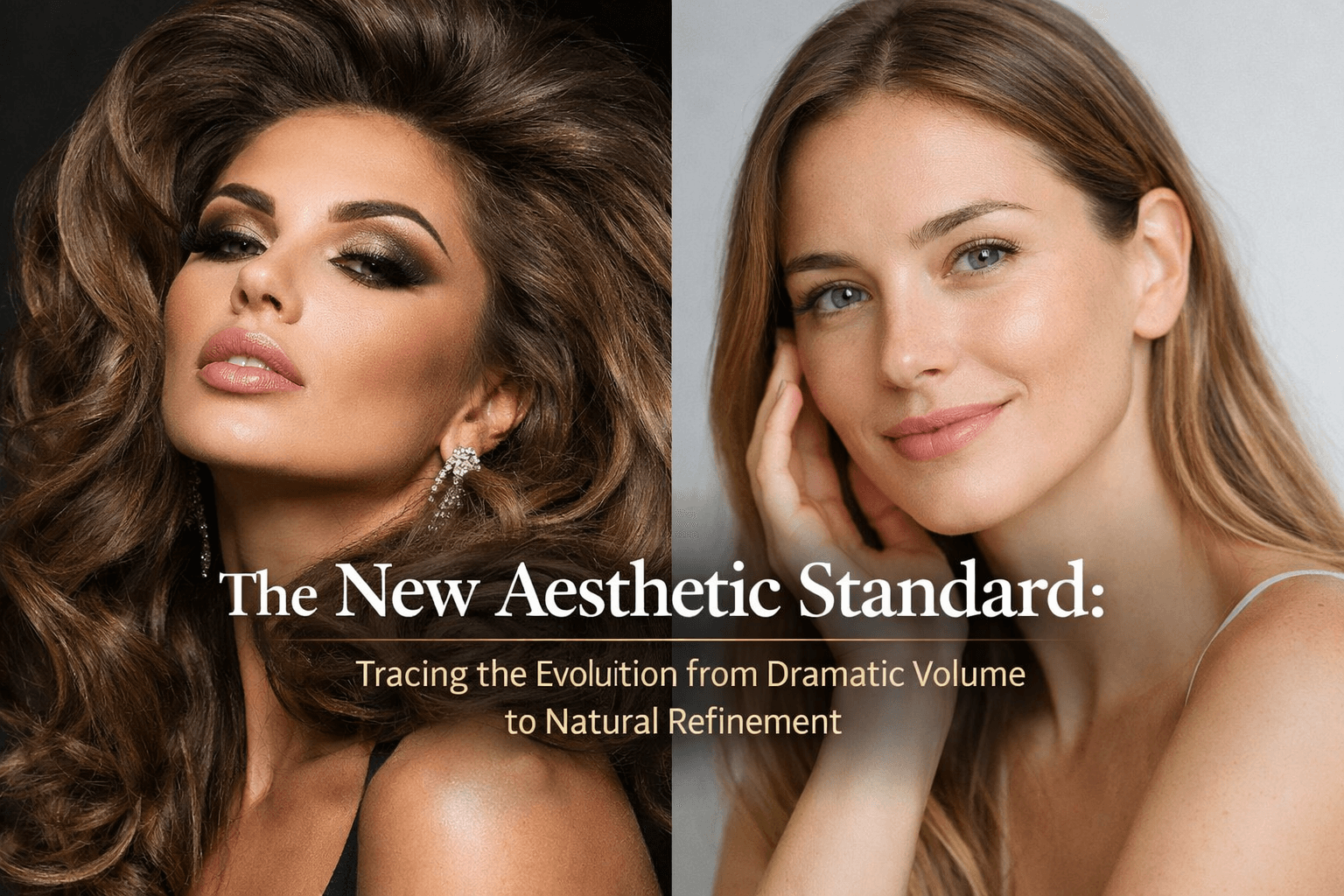
Aesthetics, like all cultural phenomena, moves in cycles. What one era considers the ideal of beauty, the next scrutinizes critically, and the history of injectable medicine over the past three decades offers one of the most instructive case studies in how medical capability, cultural influence, and evolving patient psychology interact to shape what we collectively define as beautiful. We are currently living through one of the most significant philosophical shifts the field has ever seen: a move away from visible, dramatic transformation and toward something far more scientifically sophisticated , the art of looking like yourself, only better.
At Enfield Royal Med Spa, this evolution is not simply observed it is actively practiced. The modern aesthetic standard demands restraint, anatomical precision, and a deep understanding of facial harmony rather than exaggerated volume or obvious enhancement. Treatments are no longer about changing who you are, but about refining, restoring, and subtly elevating your natural features.
Understanding how we arrived here, and what the current standard actually demands of both clinician and patient, is essential context for anyone considering aesthetic treatment today.
When injectable fillers first entered mainstream aesthetic practice in the late 1990s and early 2000s, the prevailing clinical model of facial aging was relatively simple: aging faces lose volume, and therefore restoring youth means adding volume. This was not wrong , volume loss is, as explored throughout this series, a genuine and central component of facial aging. But the model was incomplete, and the tools available were blunt by today’s standards.
Early HA formulations had limited rheological sophistication. Products were broadly categorized as thick or thin, deep or superficial, and the nuanced understanding of G’ (elastic modulus), cohesivity, and tissue plane specificity that governs modern product selection did not yet exist in clinical practice. The cultural moment compounded the clinical limitations. The mid-2000s were a period of conspicuous consumption in aesthetics , an era in which visible enhancement signaled wealth, access, and the ambition to defy aging. Fuller lips, rounder cheeks, and lifted brows were aesthetic goals pursued openly and boldly.
Social media did not yet exist. There was no Instagram to democratize beauty ideals or to amplify the consequences of poor technique to a global audience. The feedback loop between outcome and cultural standard was slow.
By the mid-2010s, the limitations of volume-centric aesthetics had become impossible to ignore , not primarily in the clinic, but on the cultural stage. The proliferation of smartphones, high-definition cameras, and social media platforms created an unprecedented public archive of aesthetic outcomes. Suddenly, the results of injectable treatment were visible, catalogued, and compared at scale.
What this revealed was a pattern. Years of cumulative, volume-dominant treatment , frequently without the anatomical selectivity now standard in elite practice , had produced a recognizable look: the overinflated midface, the smoothed-away dynamic expression, the widened and rounded face that had lost its individual character. Dermatologists and plastic surgeons began using the term “filler fatigue” , not merely as colloquial criticism but as a genuine clinical phenomenon. Patients were presenting requesting dissolution of previously placed filler not because of complications, but because they no longer recognized themselves.
The academic literature tracked this shift. A 2019 paper in JAMA Facial Plastic Surgery analyzing social media-driven aesthetic trends noted a growing patient-reported preference for outcomes that preserved facial movement, individuality, and ethnic identity , directly contrasting with the homogenized, heavily volumized aesthetic that had dominated the preceding decade. The concept of the “Instagram face” , a term coined by journalist Jia Tolentino and subsequently adopted in academic aesthetic discourse , captured the paradox perfectly: in seeking to look their best, many patients had inadvertently converged on a single, algorithmically optimized template of attractiveness that erased the very individuality that made them distinctive.
The shift toward natural refinement is not merely a cultural preference , it reflects genuine advances in anatomical understanding and technique. The research reviewed throughout this series forms the scientific bedrock of what the current aesthetic standard demands.
Anatomical selectivity , the recognition that facial fat is organized into discrete compartments with distinct aging timelines, and that the skeleton beneath resorbs in site-specific, predictable patterns , means that modern treatment targets deficits precisely rather than filling broadly. The goal is to restore what has been lost in the specific anatomical location where it was lost, at the depth where it originally resided. A patient with isolated deep medial cheek fat deflation does not need global midface augmentation , they need targeted restoration at that compartment, which will reconstitute natural contour without altering the proportional relationships that define their face.
Rheological matching , the discipline of selecting a filler product whose physical properties (G’, viscosity, cohesivity, hydrophilicity) are appropriate for the specific tissue plane and anatomical zone being treated , prevents the tissue distortion, migration, and overcorrection that characterized the volume era. A high-G’ structural product placed at the periosteum of the malar eminence behaves fundamentally differently from a low-G’, soft, hydrophilic product placed in the superficial dermis of the lip , and using each correctly is a matter of material science, not brand loyalty.
Layered, hierarchical restoration , building from deep skeletal support upward through fat compartment replenishment to superficial skin quality enhancement , produces results that move naturally with the face, integrate seamlessly with surrounding tissue, and respect the three-dimensional spatial relationships that define each individual’s unique facial character.
No discussion of the evolution toward natural aesthetics is complete without addressing the parallel revolution in neuromodulator use , the botulinum toxin injections that modulate facial muscle activity. The early era of neuromodulator use mirrored the volume era of fillers: maximum immobilization of expressive muscles was considered the gold standard. Frozen foreheads and absence of crow’s lines were the explicit treatment goals.
The current paradigm has inverted this logic. Micro-dosing and selective muscle targeting , delivering lower toxin concentrations to preserve partial movement while softening, rather than eliminating, dynamic lines , has emerged as the technical ideal. The objective is a face that moves expressively and authentically but recovers more gracefully from movement. Clinical evidence supporting this approach includes improved patient satisfaction scores and dramatically reduced rates of the brow ptosis, lateral brow heaviness, and frozen upper-face appearance that plagued the maximum-dose era.
The harmonious integration of neuromodulators and fillers , each calibrated to work with the face’s natural dynamics rather than against them , is the defining technical signature of contemporary high-level aesthetic practice.
Perhaps the most meaningful driver of the new aesthetic standard is a fundamental shift in what patients are actually seeking when they come to a clinic. Research in aesthetic psychology , including studies published in the Aesthetic Surgery Journal examining patient motivation across age cohorts , consistently finds that the dominant contemporary motivation is not transformation but identity preservation: the desire to look like the best, most vital version of themselves, rather than a younger version of someone else.
This distinction has profound clinical implications. It means that the consultation is no longer primarily a technical exercise in deficit mapping , though that remains essential , but also a conversation about identity, values, and what aspects of one’s appearance are considered characteristic and worth preserving. Ethnic and cultural identity, in particular, has moved into the foreground of aesthetic discourse. The scientific literature increasingly supports treatment frameworks that celebrate rather than homogenize morphological diversity , recognizing that the proportions, contours, and soft tissue characteristics that define beauty in one population may be entirely different from another.
The new aesthetic standard is, in many ways, a harder standard to meet than its predecessor. Dramatic volume addition requires less anatomical precision than micro-targeted, anatomy-respecting refinement. Freezing all movement is technically simpler than calibrating partial preservation. Transformation is more immediately visible , and more immediately rewarded with patient enthusiasm , than the quiet, almost invisible result of a perfectly executed, natural rejuvenation.
But the patients who receive the latter , who look at photographs from three months after treatment and cannot point to what was done, only that they look remarkably well , are the patients who return consistently, who trust their clinician implicitly, and whose faces remain coherently, recognizably, beautifully their own across decades of treatment.
That is the standard worth pursuing. And it begins, always, with a clinical approach rooted in anatomy, material science, and an honest understanding of what each individual face needs , not what any era’s aesthetic trend dictates.
Let Us Know Where to Send Your Code
Valid once per new client. Expires in 30 day