 Skip to content


Laser Hair Removal in Melbourne, FL: 7 Body Areas, 1 Clinic Near You
Laser hair removal at Enfield Royal Clinic in Brevard County , FL, delivers permanent hair reduction across 7 body areas in 6–8 sessions spaced 4–6 weeks apart. As one of the most clinically validated non-surgical aesthetic procedures available, laser hair removal “also called laser epilation or photoepilation” uses concentrated light energy to target the hair follicle at its root, progressively reducing regrowth with each treatment. Enfield Royal Clinic operates from its Viera location and serves patients across Melbourne, Rockledge, and the broader Brevard County area, providing practitioner-administered treatments under clinical supervision.
The demand for permanent hair reduction continues to grow across the Space Coast. Patients in Melbourne, FL choose laser hair removal not only for convenience but for the long-term reduction in shaving, waxing, and ingrown hair cycles. Laser hair removal at Enfield Royal Clinic is administered by trained clinical practitioners using our advanced laser system, with treatment plans tailored to each patient’s skin type, hair colour, and target areas.
Your Quick Route to Our Viera Clinic from Melbourne
Select a location to see your route and estimated travel time
Estimated drive times to our Rockledge / Viera clinic
- Downtown Melbourne → ~18 min via US-1 N | ~14 min via I-95 N
- Melbourne Beach → ~28 min via Eau Gallie Cswy & US-1 N
- Melbourne Square Mall → ~20 min via Wickham Rd & I-95 N
- Wickham Park → ~18 min via Wickham Rd N
- MLB Airport → ~18 min via I-95 N | ~22 min via US-1 N
Clinic address: 5460 Village Dr, Rockledge, FL 32955 — easily accessible from throughout Melbourne and Brevard County.
What Is Laser Hair Removal? A Clinical Definition
Laser hair removal is a non-surgical, FDA-approved procedure that uses a single-wavelength beam of concentrated light to selectively destroy hair follicles beneath the skin’s surface, producing permanent hair reduction over a course of 6–8 sessions. It is distinct from IPL (intense pulsed light), which uses broad-spectrum light and does not meet the FDA standard for permanent hair reduction.
The procedure targets melanin, the pigment that gives hair its colour within the follicle. By converting light energy into heat, the laser disables the follicle’s capacity for regrowth without damaging the surrounding skin tissue. The result is a gradual, permanent reduction in hair density and thickness across the treated area.
Laser hair removal belongs to the broader category of energy-based aesthetic treatments. It is regulated by the FDA under the standard of “permanent hair reduction,” defined as the long-term, stable reduction in the number of regrowing hairs after a treatment protocol, which differs from complete and permanent elimination of all hair.
How Laser Hair Removal Works: Targeting the Hair Follicle
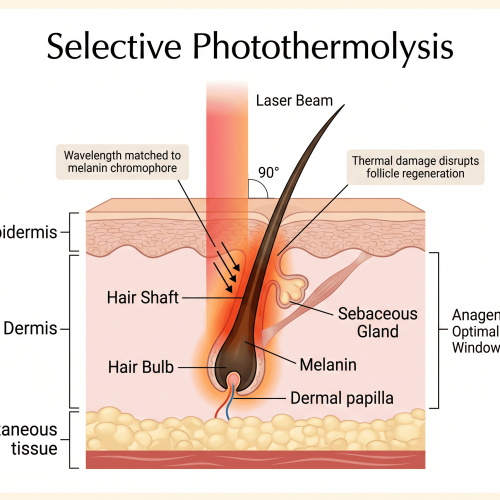
Laser hair removal operates on the principle of selective photothermolysis. The precise targeting of a specific tissue (the hair follicle) using a wavelength of light selectively absorbed by that tissue’s chromophore (melanin), while leaving surrounding structures intact. The laser delivers a calibrated pulse of energy; melanin in the hair shaft and bulb absorbs this energy, converts it to heat, and the resulting thermal damage disrupts the follicle’s ability to produce new hair.
According to research published in Lasers in Surgery and Medicine by Dr. R. Rox Anderson and Dr. John A. Parrish at Harvard Medical School, the theory of selective photothermolysis — first described in 1983 — established that tissues can be selectively destroyed by matching the wavelength of light to its target chromophore and the pulse duration to the thermal relaxation time of that target. This principle remains the scientific foundation for all modern laser hair removal systems.
The hair growth cycle determines treatment effectiveness. Each hair follicle cycles through three phases: anagen (active growth), catagen (transition), and telogen (resting). Laser energy is only effective on follicles in the anagen phase, when the hair shaft is present inside the follicle and melanin concentration is highest. Because not all follicles are in anagen simultaneously, multiple sessions — spaced 4–6 weeks apart , are required to treat the full population of follicles across a given area.
The fluence (energy delivered per unit area, measured in J/cm²) and the spot size of the laser handpiece determine both the depth of penetration and the extent of thermal damage to the follicle. Pulse duration is calibrated to the thermal relaxation time of the follicle, ensuring heat is confined to the target structure. Our advanced laser system at Enfield Royal Clinic is configured per patient skin type and treatment area to optimise both efficacy and safety.
7 Body Areas Treated at Our Enfield Royal FL Clinic
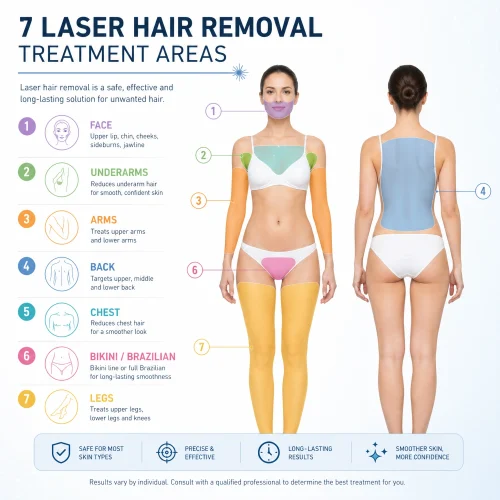
Enfield Royal Clinic treats the following 7 body areas for laser hair removal at our Viera location, serving patients from Melbourne and across Brevard County. Session counts reflect truth ranges per area — individual results vary based on hair colour, skin type, and hormonal factors.
Face Laser Hair Removal Melbourne FL
Laser hair removal on the face addresses unwanted hair on the upper lip, chin, sideburns, cheeks, and jawline. Face is the highest-demand treatment area among female patients seeking laser hair removal in Melbourne, FL, and one of the fastest to respond to treatment due to the generally finer hair texture in facial regions.
The upper lip and chin typically require 4–6 sessions spaced 4–6 weeks apart, with results visible from the third session onward. Sideburns and cheek coverage may require 5–7 sessions depending on hair density. Each facial session at Enfield Royal Clinic takes 15–20 minutes. Hormonal factors — including conditions such as PCOS — may influence regrowth patterns; patients with hormonally driven facial hair may benefit from maintenance sessions every 12–18 months following their initial treatment protocol.
Bikini & Brazilian Laser Hair Removal
Bikini and Brazilian laser hair removal ranks among the most searched treatment areas nationally. Laser hair removal in the bikini region offers patients a permanent reduction alternative to ongoing waxing cycles, eliminating the risk of ingrown hairs, post-wax irritation, and the recurrence cost of temporary methods.
A standard bikini laser treatment addresses hair along the bikini line. A Brazilian treatment extends coverage to the full pubic region. Session requirements for both typically fall within the 4–8 session range, spaced 4–6 weeks apart. Brazilian laser hair removal achieves permanent reduction when hormonal factors remain stable; patients experiencing hormonal fluctuations — including pregnancy or hormonal therapy — may observe partial regrowth and benefit from additional sessions. Our clinical practitioners at Enfield Royal Clinic assess each patient’s case individually before commencing treatment.
Leg Laser Hair Removal (Full & Half)
Leg laser hair removal is available as full leg treatment or half leg treatment at Enfield Royal Clinic’s Viera clinic. Full leg laser hair removal is one of the most comprehensive body treatments, covering the entire surface from hip to ankle.
Full leg sessions require 6–10 sessions spaced 4–6 weeks apart, reflecting the larger surface area and the coarser hair typically found in the lower leg. Full leg sessions take 45–60 minutes. Half leg treatments — covering either upper or lower leg — take 25–30 minutes per session. Patients commonly combine full leg treatment with bikini laser hair removal for a comprehensive lower body protocol.
Underarm Laser Hair Removal
Underarm laser hair removal produces some of the fastest visible results of any treatment area. The underarm region has a relatively small surface area, and the hair is typically coarse and dark — characteristics that respond well to laser energy.
Most patients require 4–6 underarm sessions spaced 4–6 weeks apart. Each underarm session takes 15–20 minutes. Patients typically notice measurable hair reduction after 2–3 sessions, making the underarm area a favoured starting point for patients who are new to laser hair removal and considering a larger treatment protocol.
Back & Chest Laser Hair Removal
Back and chest laser hair removal addresses the most commonly treated areas among male patients seeking laser hair removal in Melbourne, FL. The back is among the largest treatment surfaces, and coarser hair in these regions corresponds to higher session counts.
Back laser hair removal requires 6–10 sessions spaced 4–6 weeks apart. Full back sessions take 45–60 minutes. Chest hair removal, covering the pectoral and upper abdominal region, requires 6–8 sessions with sessions of 30–45 minutes. Enfield Royal Clinic’s practitioners develop treatment plans for male patients that account for hormonal influences on back and chest hair density.
Arms Laser Hair Removal
Arms laser hair removal is available for full arms (shoulder to wrist) or forearms only at Enfield Royal Clinic. Full arm treatment covers the upper arm, elbow, and forearm. Forearm laser hair removal is a growing treatment area among patients seeking to reduce arm hair without the repetitive maintenance of shaving or waxing.
Full arm laser hair removal requires 6–8 sessions spaced 4–6 weeks apart. Forearm-only sessions are typically 4–6 sessions. Patients in Melbourne, FL seeking laser hair removal on the forearms and lower arm specifically will find this a clinically effective option, as the hair in this region is commonly fine to medium in texture and responds well across multiple sessions.
Neck & Neckline Laser Hair Removal
Neck and neckline laser hair removal addresses hair on the back of the neck, the neckline, and the lower face–neck transition zone. This area is a frequent source of ingrown hairs, particularly in patients who shave the neckline regularly. Laser hair removal on the neck eliminates the follicle cycle that produces ingrown hairs, reducing post-shave irritation and folliculitis over the course of treatment.
Neck sessions require 4–6 sessions spaced 4–6 weeks apart. Each session takes 15–20 minutes. Patients experiencing recurrent ingrown hairs on the neck and neckline may also benefit from a consultation on skin condition management alongside their laser treatment plan.
What Laser Technologies Does Enfield Royal Clinic Use for Hair Removal?
Medical-grade laser hair removal is not a single device — it is a category of technologies, each defined by a specific wavelength of light and a corresponding depth of follicle penetration. The three laser systems most widely used in clinical laser hair removal practice are Diode laser, Nd:YAG laser, and Alexandrite laser, each optimised for a different range of skin phototypes and hair characteristics. A fourth technology, IPL (Intense Pulsed Light), is frequently marketed as laser hair removal but is clinically and technically distinct. The following section explains each system and its clinical application.
Diode Laser (810 nm)
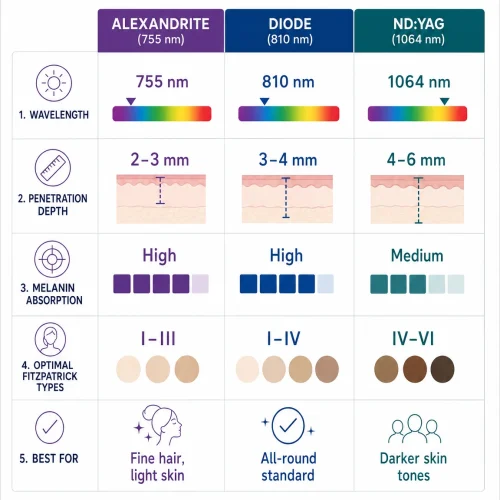
The Diode laser operates at 810 nm, a wavelength that sits within the near-infrared spectrum and penetrates to the mid-dermis — the depth at which the hair follicle bulb and bulge reside. At 810 nm, melanin absorption is high enough to deliver effective thermal damage to the follicle while remaining safe for the epidermis across a broad range of skin phototypes. The Diode laser is considered the gold-standard wavelength for laser hair removal on Fitzpatrick skin types I–IV and is used in many clinical settings as the primary hair removal system.
Key clinical characteristics of the Diode laser: wavelength 810 nm · penetration depth 2–4 mm · primary chromophore melanin · optimal phototype range Fitzpatrick I–IV · fast repetition rate enables large-area treatment in shorter session times · integrated cooling systems protect the epidermis during pulse delivery.
Nd:YAG Laser (1064 nm)
The Nd:YAG laser operates at 1064 nm, the longest wavelength among the three primary hair removal systems. At this wavelength, melanin absorption in the epidermis is significantly lower than at 810 nm or 755 nm, which means epidermal heating is reduced and the risk of post-inflammatory hyperpigmentation in darker skin tones is substantially decreased. The 1064 nm wavelength penetrates deeper into the dermis — reaching 5–7 mm — allowing effective follicle targeting in higher phototype patients where shallower wavelengths carry greater safety risk.
Key clinical characteristics of the Nd:YAG laser: wavelength 1064 nm · penetration depth 5–7 mm · lower epidermal melanin absorption · optimal phototype range Fitzpatrick IV–VI · may require higher fluence or additional sessions compared to Diode for lighter phototypes · the preferred wavelength for patients with darker skin tones seeking permanent hair reduction.
Alexandrite Laser (755 nm)
The Alexandrite laser operates at 755 nm, within the red portion of the visible light spectrum. At this wavelength, melanin absorption is highest among the three primary systems, producing strong thermal damage to pigmented follicles with lower fluence requirements. The Alexandrite laser penetrates to 2–3 mm, making it highly effective for fine-to-medium hair in lighter phototype patients. Its high melanin affinity makes it the fastest-acting system for Fitzpatrick types I–III, often delivering visible reduction after fewer sessions than Diode or Nd:YAG for this candidate profile.
Key clinical characteristics of the Alexandrite laser: wavelength 755 nm · penetration depth 2–3 mm · highest melanin absorption coefficient of the three systems · optimal phototype range Fitzpatrick I–III · fast treatment times for smaller areas · not recommended for Fitzpatrick types V–VI due to elevated epidermal absorption risk.
IPL (Intense Pulsed Light) — Why It Is Not Laser Hair Removal
IPL is not a laser. It uses a broadband flashlamp that emits multiple wavelengths simultaneously (typically 515–1200 nm), whereas a laser emits a single, coherent wavelength. This distinction has direct clinical consequences: IPL energy is distributed across a wide spectral range, reducing the concentration of energy at any specific chromophore. The result is lower follicle thermal damage per pulse, requiring more sessions to achieve comparable reduction and producing less consistent outcomes, particularly on darker skin tones where off-target epidermal absorption is higher.
The FDA does not classify IPL as producing “permanent hair reduction” — the same classification applied to medical-grade laser systems. Patients in Melbourne, FL evaluating hair removal options at multiple clinics should ask whether the technology being used is a medical-grade laser (Diode, Nd:YAG, or Alexandrite) or an IPL device, as this distinction directly affects the permanence and consistency of results.
Laser Technology Comparison: Wavelength, Penetration, and Skin Type Suitability
How Many Sessions Does Laser Hair Removal Take?
Most patients require 6–8 sessions of laser hair removal, spaced 4–6 weeks apart, to achieve permanent hair reduction across general body areas. This range reflects the anagen-phase dependency of laser efficacy: because only actively growing follicles respond to laser energy, multiple sessions are required to intercept the full follicle population of any given area across its growth cycles.
Sessions vary in number if skin tone, hair colour, or hormonal factors differ from the typical candidate profile. Lighter hair (blonde, grey, or red) contains less melanin and requires more sessions to achieve comparable reduction. Darker skin tones require careful parameter calibration to protect the epidermis while delivering sufficient energy to the follicle. The following session ranges are the canonical values used by Enfield Royal Clinic across its treatment protocols:
| Treatment Area | Recommended Sessions | Notes |
|---|---|---|
| Face & Underarms | 4–6 sessions | Fine hair, smaller area, faster anagen cycling |
| Bikini & Brazilian | 4–8 sessions | Hormonal influence may extend protocol |
| Arms (Full) | 6–8 sessions | Larger surface area |
| Arms (Forearm Only) | 4–6 sessions | Smaller area compared to full arms |
| Legs (Full) | 6–10 sessions | Larger area, thicker hair |
| Legs (Half) | 5–8 sessions | Moderate surface area |
| Back & Chest | 6–10 sessions | Coarser hair, larger surface area |
| Neck & Neckline | 4–6 sessions | Moderate density, smaller treatment area |
Following completion of an initial treatment protocol, most patients benefit from 1 maintenance session every 12–18 months to address any follicles that become active due to hormonal changes or seasonal variation in hair growth cycles. The precise maintenance schedule is determined at post-treatment review.
Who Is a Good Candidate for Laser Hair Removal in Melbourne, FL ?
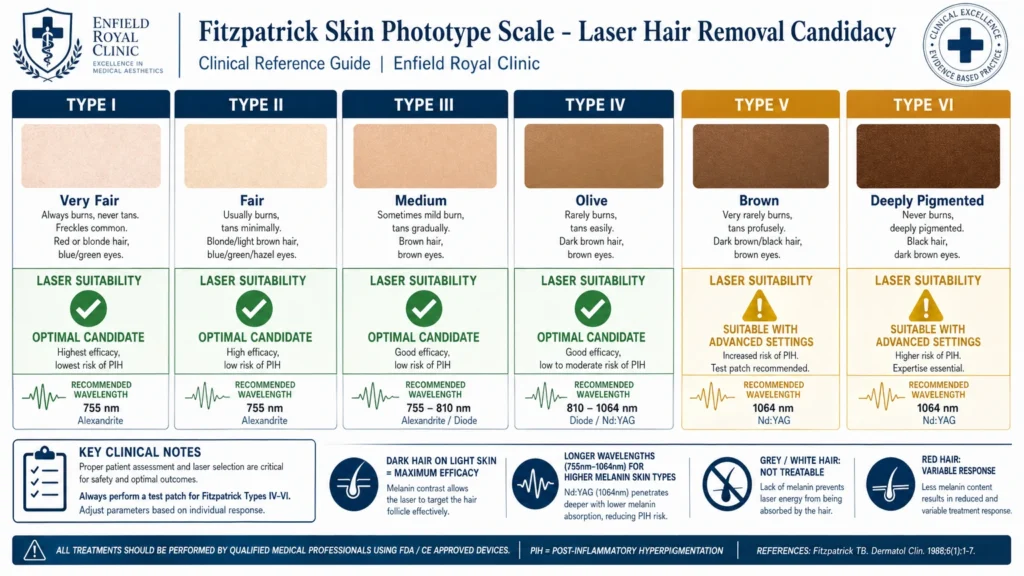
Laser hair removal produces the most consistent permanent reduction in patients with a high contrast between hair colour and skin tone — specifically, dark hair against lighter skin. This contrast maximises melanin absorption in the follicle while minimising energy absorption by the surrounding epidermis.
Patient candidacy is assessed using the Fitzpatrick skin phototype scale (Types I–VI), which classifies skin tone from very fair (Type I) to deeply pigmented (Type VI). According to guidelines published by the American Society for Laser Medicine and Surgery (ASLMS), Fitzpatrick types I–IV are optimal candidates for laser hair removal using standard wavelength configurations. Patients with Fitzpatrick types V–VI may still achieve significant permanent reduction when the correct laser wavelength and parameter settings are selected; longer wavelengths penetrate more deeply and carry lower epidermal absorption risk in higher melanin skin types. Enfield Royal Clinic assesses each patient’s Fitzpatrick type at consultation and configures our advanced laser system accordingly.
Hair colour is the second major candidacy variable. Dark brown and black hair respond most effectively across all skin types. Blonde and light brown hair contain lower melanin concentration and may require more sessions to achieve comparable reduction. Grey and white hair, which contain no melanin, do not respond to standard laser hair removal. Red hair may respond partially depending on the pheomelanin concentration.
Patients with certain medical conditions or taking photosensitising medications should disclose this information at consultation. Pregnancy is a contraindication. Active skin infections or inflammatory conditions in the treatment area require resolution before treatment commences.
Is Laser Hair Removal Painful?
Patients often describe the sensation during laser hair removal as a mild to moderate discomfort, akin to a rubber band snapping against the skin. The level of discomfort can vary depending on the treated area, individual pain threshold, and the specific laser settings used. Sensitive areas, such as the bikini line or upper lip, may experience more sensation than larger areas like the legs or back. Modern laser systems often incorporate cooling mechanisms, such as chilled tips or integrated cooling systems, to enhance patient comfort during the procedure
Kaitlin Messick - FNP
What to Expect Before, During, and After Your Session
Before Your Session
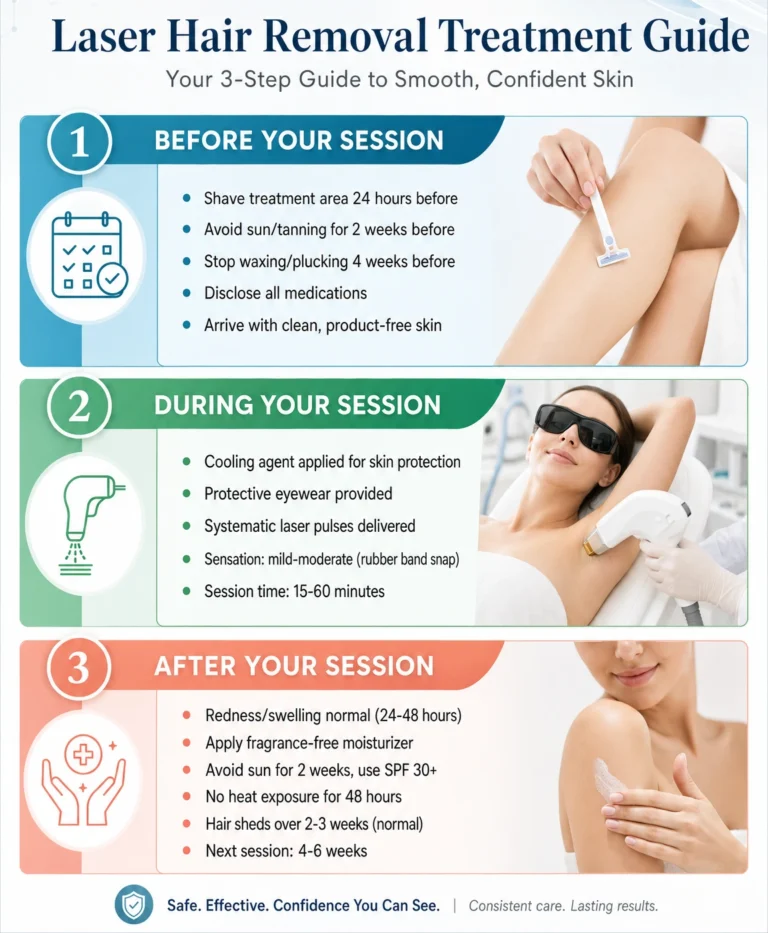
Preparing correctly for your laser hair removal session improves both the safety and efficacy of the treatment. The following steps apply to all treatment areas:
- Shave the treatment area 24 hours before your session. You should not arrive with visible hair above the skin surface — surface hair absorbs laser energy and reduces the amount reaching the follicle.
- Avoid sun exposure, tanning beds, and self-tan products for at least 2 weeks before treatment. Elevated epidermal melanin from tanning increases the risk of surface burns and reduces the contrast between skin and follicle.
- Discontinue waxing, plucking, and electrolysis for at least 4 weeks before your first session. These methods remove the hair shaft from the follicle, eliminating the melanin pathway required for laser targeting.
- Disclose all medications at consultation, particularly retinoids, antibiotics, and photosensitising drugs, as these may require a treatment delay.
- Arrive with clean, product-free skin on the treatment area. Do not apply moisturiser, deodorant, or cosmetics on the day of your session.
During Your Session
Your practitioner will apply a topical cooling agent or use an integrated cooling mechanism in the handpiece to protect the skin surface during treatment. You will be provided with protective eyewear. The laser handpiece is passed across the treatment area in systematic sections, delivering calibrated pulses of energy.
Most patients describe the sensation as mild to moderate discomfort, comparable to the snap of a rubber band against the skin. Sensation intensity varies by area and individual pain threshold — areas with thinner skin or higher nerve density, such as the upper lip and bikini line, may feel more intense. Sessions range from 15–60 minutes depending on the area treated.
After Your Session
Immediately following treatment, the skin in the treated area may appear red and mildly swollen, similar to a mild sunburn. This is a normal inflammatory response and typically resolves within 24–48 hours. The following post-care steps apply to all areas:
- Apply a fragrance-free, gentle moisturiser or the post-treatment product recommended by your practitioner to the treated area.
- Avoid direct sun exposure for 2 weeks post-treatment. You should apply broad-spectrum SPF 30 or higher to any treated area exposed to daylight.
- Refrain from heat exposure — including saunas, steam rooms, and hot baths — for 48 hours post-session to allow the inflammatory response to resolve.
- Expect hair shedding from the treated follicles over the 2–3 weeks following your session. This is normal and indicates successful follicle disruption, not regrowth.
- Book your next session 4–6 weeks after treatment to intercept the next anagen phase of the hair growth cycle.
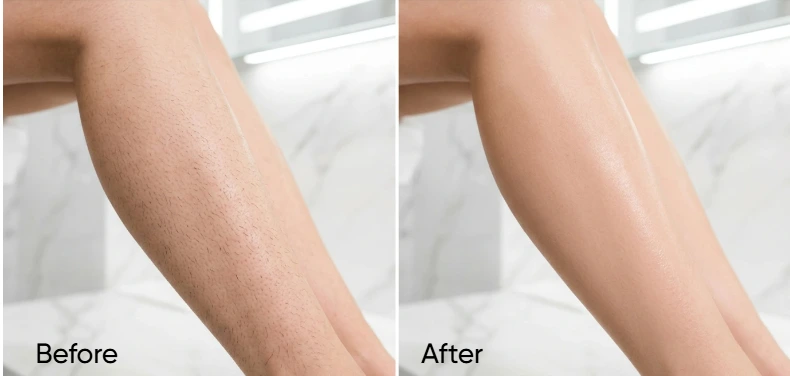
See Real Transformations
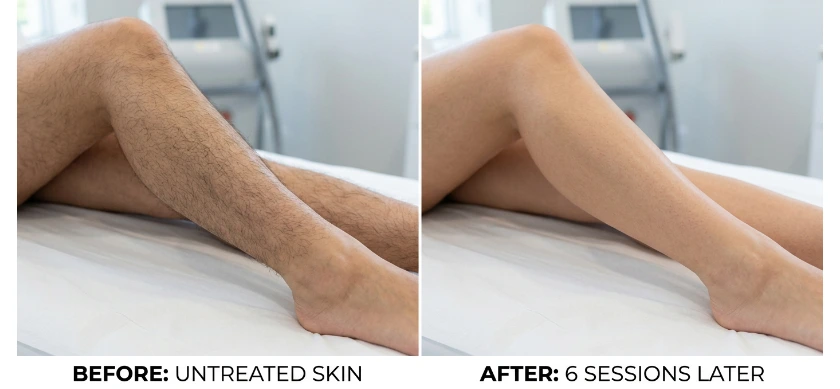
Laser vs Waxing vs IPL: Which Removes Hair Permanently?
Not all hair removal methods deliver the same clinical outcome. Laser hair removal, IPL, waxing, and shaving differ fundamentally in their mechanism of action, permanence, and long-term cost. The following comparison uses FDA terminology and clinical definitions to distinguish each method:
Method | Permanence | Sessions Needed | Best Candidate |
Laser Hair Removal | Permanent reduction (FDA-approved term) | 6–8 sessions, 4–6 weeks apart | Fitzpatrick types I–IV (optimal); types V–VI with appropriate wavelength |
IPL (Intense Pulsed Light) | Long-term reduction; not classified as permanent removal | 8–12+ sessions typical | Fair to light skin, light hair; less effective on darker tones |
Waxing | No permanent effect; hair regrows within 3–6 weeks | Ongoing — every 3–6 weeks indefinitely | All skin types, but cumulative cost exceeds laser over 2–3 years |
Shaving | No reduction; removes hair at skin surface only | Daily to every few days, indefinitely | All skin types; no follicle disruption |
IPL (intense pulsed light) is frequently offered by beauty salons and some clinics in Melbourne, FL as an alternative to laser hair removal. The distinction matters: IPL uses broad-spectrum light across multiple wavelengths, which limits its energy concentration at the target follicle and reduces its efficacy on darker hair or skin tones. Medical-grade laser hair removal uses a single calibrated wavelength, delivering higher fluence precisely to the follicle chromophore. The FDA classifies laser hair removal as producing permanent hair reduction; IPL is not held to the same regulatory standard.
Waxing and shaving provide no follicle disruption. Waxing removes the hair shaft at or below the skin surface but leaves the follicle intact and capable of regrowth within 3–6 weeks. Over a 10-year period, the cumulative cost of regular waxing for a primary area typically exceeds the cost of a complete laser protocol.
Is Laser Hair Removal Safe for All Skin Tones? (Melbourne Patients)
Laser hair removal is safe for patients across all Fitzpatrick skin types when the correct laser wavelength and parameter settings are used. The safety profile of the procedure for patients with darker skin tones has improved significantly as laser technology has advanced. Earlier laser systems were primarily calibrated for Fitzpatrick types I–III; contemporary medical-grade systems allow practitioners to treat types IV–VI with appropriate wavelength selection and reduced fluence.
A study published in the Journal of Clinical and Aesthetic Dermatology examining laser hair removal outcomes across Fitzpatrick types I–VI found that patients with types V and VI achieved clinically significant permanent hair reduction when treated with appropriate laser parameters and sufficient session counts. The authors noted that longer wavelengths carry lower melanin absorption in the epidermis and penetrate more deeply to the follicle, reducing the risk of post-inflammatory hyperpigmentation in higher phototype patients.
Patients with Melbourne’s diverse demographic range — including individuals with South Asian, Hispanic, Middle Eastern, and African heritage, all of whom may present with Fitzpatrick types IV–VI — are candidates for laser hair removal at Enfield Royal Clinic, subject to individual assessment at consultation. The caution is not whether treatment is possible, but whether the practitioner correctly configures the system for the patient’s phototype. This assessment is a standard component of every Enfield Royal Clinic consultation.
Patients with active skin conditions, recent sun exposure, or photosensitising medications may require a treatment delay. These are temporary contraindications, not permanent exclusions. Your practitioner at Enfield Royal Clinic will review your full clinical picture at consultation and confirm your suitability before any session commences.
For a complete overview of laser and energy-based treatments available at Enfield Royal Clinic, visit laser treatments hub. To learn more about the science of laser hair removal, including how selective photothermolysis targets the hair follicle, refer to our laser hair removal treatment guide
Faqs
Laser hair removal produces permanent hair reduction, defined by the FDA as a long-term, stable reduction in the number of regrowing hairs following a complete treatment protocol. Most patients complete 6–8 sessions and experience permanent reduction across the treated area. Some follicles may become active again over time due to hormonal changes, which is why 1 maintenance session every 12–18 months is recommended following protocol completion. The results are not time-limited in the way waxing or shaving is — the follicles that have been successfully disabled do not recover.
Laser hair removal on tanned skin carries an increased risk of epidermal burns and post-inflammatory hyperpigmentation. Tanning — whether from sun exposure, tanning beds, or self-tan products — raises the melanin concentration in the epidermis, reducing the contrast between skin and follicle and increasing the risk of off-target thermal damage. You should avoid sun exposure and all tanning products for at least 2 weeks before each session. In Melbourne, FL’s climate, this requires consistent sun avoidance and daily SPF application throughout your treatment protocol. If you arrive for a session with visible tan, your practitioner may defer treatment until the tan fades.
Full body laser hair removal requires a session count that varies by area, as different body zones have different hair density, growth cycles, and follicle depth. As a general guide: face and underarms require 4–6 sessions; bikini and Brazilian require 4–8 sessions; arms require 6–8 sessions; legs require 6–10 sessions; back and chest require 6–10 sessions. For a full body protocol, most patients complete between 6–10 sessions across all areas, with each session spaced 4–6 weeks apart. Enfield Royal Clinic practitioners develop a phased full-body treatment plan at consultation, prioritising areas by treatment order and spacing sessions to align with each area’s anagen cycle.
Laser hair removal is not recommended during pregnancy. While there is no established evidence of direct harm to a developing foetus from laser energy confined to the skin surface, the absence of controlled clinical trial data in pregnant populations means that the precautionary standard across dermatology and aesthetic medicine is to defer treatment until after delivery and the completion of breastfeeding. Hormonal changes during pregnancy also alter the hair growth cycle, which may reduce treatment efficacy and increase the risk of regrowth following sessions conducted during this period.
Hair shedding and apparent regrowth after a session are normal and expected. What appears to be regrowth in the 2–3 weeks following a session is typically shedding — treated follicles expelling the damaged hair shaft from beneath the skin. True regrowth occurs because not all follicles are in the anagen (active) phase at the time of treatment. Laser energy only disrupts follicles that contain an active hair shaft with sufficient melanin. Follicles in the catagen or telogen phase at the time of treatment will cycle into anagen subsequently and are targeted in later sessions. This is why a minimum of 6–8 sessions is required to achieve comprehensive permanent reduction across a given area.
Laser hair removal and electrolysis are both FDA-recognised methods of permanent hair reduction, but they operate on different principles and suit different patient profiles. Laser hair removal uses concentrated light energy to target melanin in multiple follicles simultaneously, making it time-efficient for large areas such as the legs, back, and full bikini zone. Electrolysis uses a fine needle inserted into each individual follicle to deliver electrical current, disabling the follicle one at a time. Electrolysis is the only FDA-recognised method for truly permanent hair removal (not just reduction) and is effective on all hair colours, including grey and white hair that do not respond to laser. However, treating large areas with electrolysis requires a substantially higher number of appointments and total treatment time. For patients with dark hair and areas larger than the upper lip or eyebrows, laser hair removal at Enfield Royal Clinic is the more clinically practical and time-efficient choice.
Book Your Free Laser Hair Removal Consultation at Enfield Royal Clinic , FL
Enfield Royal Clinic provides laser hair removal for Melbourne, FL patients from our Viera clinical location in Brevard County. Our Viera clinic serves patients from Melbourne, Rockledge, Cocoa Beach, Palm Bay, and the broader Space Coast region. Laser hair removal at Enfield Royal Clinic’s Viera location is administered by our licensed clinical practitioners.
A free consultation includes a Fitzpatrick skin type assessment, treatment area review, session count estimate, and full review of your medical history and current medications. There is no obligation to commence treatment at the consultation appointment.
To book your free consultation, contact Enfield Royal Clinic by phone, by online booking, or by visiting our clinic directly. We serve Melbourne, FL patients on a flexible appointment schedule, with early morning and weekend availability at our Viera location.
Serving: Melbourne FL · Viera FL · Rockledge FL · Cocoa Beach FL · Palm Bay FL · Brevard County FL Enfield Royal Clinic provides non-surgical aesthetic treatments across Florida, with our primary location serving Brevard County and the Space Coast.
request for quotation & consultation
To schedule a free consultation
or receive our detailed price list by email, complete the form.