


 Skip to content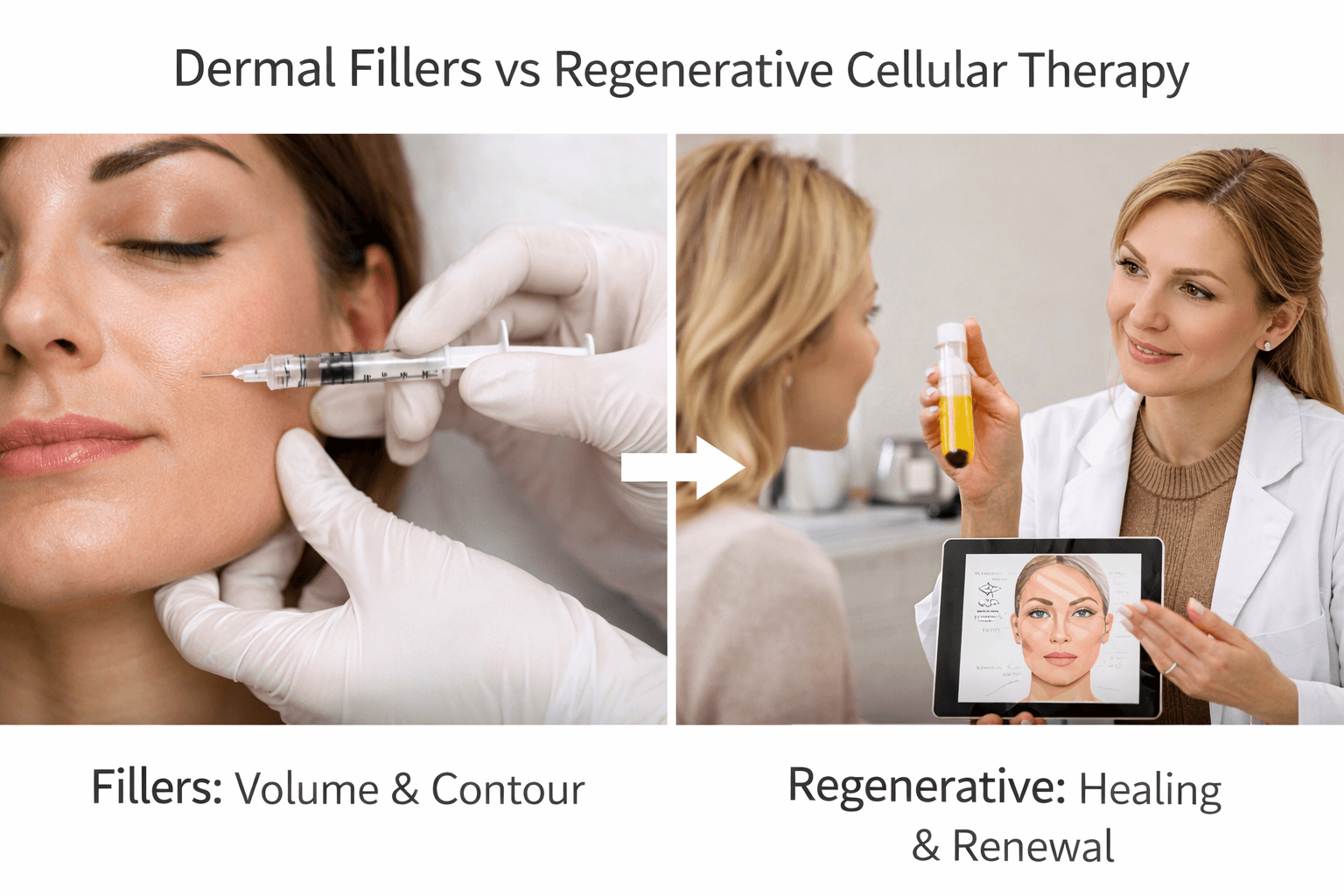
For most of the history of aesthetic injectable medicine, the fundamental treatment logic has been additive: identify a deficit, introduce a material to fill it, and observe the result. This paradigm ,elegant in its simplicity and validated by decades of clinical outcome data ,has produced transformative results for millions of patients worldwide. But it operates, at its core, as a substitute for what was lost rather than a restoration of the biological machinery responsible for producing it in the first place.
A quiet revolution has been building in the scientific literature for over a decade, and it is now arriving at the clinic door. Regenerative medicine ,the field dedicated to harnessing, amplifying, or replicating the body’s own cellular repair and renewal systems ,is fundamentally reframing the question aesthetic medicine asks. Rather than what can we add to replace what aging has removed, the regenerative approach asks: can we restore the biological processes that aging has silenced? The distinction is not merely philosophical. It has direct, measurable consequences for the quality, durability, and biological authenticity of aesthetic outcomes.
To understand what regenerative science offers, it is worth being precise about what fillers ,even the most sophisticated modern formulations ,cannot do. Hyaluronic acid, calcium hydroxylapatite, and poly-L-lactic acid, as explored in depth in this series, each address aging through distinct mechanisms. HA restores hydration and soft tissue volume. CaHA provides structural scaffolding and recruits new collagen. PLLA stimulates neocollagenesis through a controlled foreign body response. These are genuinely meaningful biological interactions, and the biostimulatory agents in particular represent a meaningful bridge between the filling and regenerative paradigms.
But even PLLA, the most biologically active of the conventional filler class, works by exploiting an inflammatory reaction to a synthetic foreign particle ,a mechanism that is fundamentally reactive rather than regenerative. The collagen it stimulates is real, but the signal that triggers it is artificial. The deeper biological substrate ,the fibroblast population density, the stem cell niche, the extracellular matrix microenvironment, the growth factor signaling networks ,remains unaddressed.
Aging skin is not simply deficient in volume. It is a tissue in progressive biological decline: fibroblast senescence reduces the skin’s capacity to synthesize and organize collagen; stem cell exhaustion in the dermal and epidermal niches impairs cellular renewal; chronic low-grade inflammation ,now termed “inflammaging” in the geroscience literature ,degrades the extracellular matrix faster than it can be replenished; and the growth factor signaling environment that coordinates tissue repair becomes progressively dysregulated. Filling the visible consequences of these processes without addressing their biological drivers is, to return to the architectural metaphor, interior decoration in a building whose structure continues to deteriorate.
Platelet-Rich Plasma (PRP) ,the preparation of autologous, concentrated platelet fractions from the patient’s own blood ,represents the first and most widely established regenerative modality in aesthetic medicine, with a clinical history extending back to its orthopedic and wound healing origins in the 1980s before its adoption in dermatology.
The biological rationale is grounded in platelet biology. Upon activation, platelets degranulate and release a rich cargo of growth factors ,including Platelet-Derived Growth Factor (PDGF), Transforming Growth Factor-beta (TGF-β), Vascular Endothelial Growth Factor (VEGF), Epidermal Growth Factor (EGF), and Insulin-like Growth Factor-1 (IGF-1). These are not cosmetic molecules ,they are the primary signaling proteins the body uses to orchestrate wound repair, angiogenesis, and tissue regeneration. Delivered at supraphysiological concentrations into aged dermis, they provide a powerful pro-regenerative signal to resident fibroblasts and stem cells.
Peer-reviewed evidence supports PRP’s ability to induce meaningful neocollagenesis, improve skin texture, hydration, and elasticity, and reduce the appearance of fine rhytides. A systematic review published in the Journal of Cosmetic Dermatology by Cervantes et al. (2018) confirmed statistically significant histological improvements in dermal collagen density following PRP treatment, alongside clinically measurable improvements in skin quality indices. A key limitation, however, is the significant inter-individual variability in PRP composition and efficacy ,platelet count, activation state, and growth factor concentration vary meaningfully between patients and even between draws in the same patient, making standardization a persistent challenge.
If PRP represents regenerative medicine’s first generation, exosome therapy is its most scientifically sophisticated current frontier ,and arguably the most conceptually transformative development in aesthetic cellular science in the past decade.
Exosomes are nanoscale extracellular vesicles ,membrane-bound particles of 30 to 150 nanometers in diameter ,secreted by virtually all cell types as a primary mechanism of intercellular communication. They are not cells themselves, but carry a remarkable biological payload: microRNAs (miRNAs), messenger RNAs (mRNAs), proteins, lipids, and transcription factors that, upon delivery to recipient cells, can reprogram gene expression, modulate inflammatory cascades, and activate dormant regenerative pathways.
In the context of aesthetic medicine, the most clinically relevant exosomes are those derived from mesenchymal stem cells (MSC-exosomes) ,the secretory vesicles of the stem cell population most associated with tissue repair and regeneration. MSC-derived exosomes have been shown in both in vitro and in vivo studies to stimulate fibroblast proliferation, upregulate collagen and elastin synthesis, suppress senescence-associated inflammatory signaling, and promote angiogenesis ,essentially delivering the regenerative signaling capacity of stem cells without the regulatory complexities, safety concerns, and logistical challenges of cell transplantation itself.
A landmark study published in Theranostics by Hu et al. (2019) demonstrated that topically applied MSC-derived exosomes significantly accelerated wound healing and collagen remodeling in a controlled murine model, while clinical pilot studies in human subjects have shown promising improvements in skin elasticity, pore size, and fine line depth following intradermal exosome delivery. Research published in the Journal of Extracellular Vesicles has begun mapping the specific miRNA cargo responsible for these effects ,particularly miR-21, miR-23a, and miR-125b ,providing molecular specificity to what was previously understood only at the phenotypic level.
It is important to be scientifically transparent here: the clinical evidence base for exosome therapy in aesthetic dermatology, while rapidly expanding and biologically compelling, remains younger and less methodologically robust than that supporting established filler modalities or PRP. Regulatory frameworks for exosome products vary significantly across jurisdictions. The field is moving quickly, and not all commercially available exosome products are equivalent in sourcing, processing, characterization, or quality control. Patients should engage with this modality through clinicians who demonstrate genuine scientific literacy about the products they use ,not simply familiarity with their marketing.
Polynucleotides (PNs) ,long-chain DNA fragments derived primarily from salmon or trout sperm, processed to remove proteins and cellular debris ,represent a distinct and increasingly evidence-supported regenerative modality that operates through a specific and well-characterized molecular mechanism.
PN molecules act primarily as purinergic receptor agonists, binding adenosine receptors on fibroblasts to directly stimulate proliferation and collagen synthesis, while simultaneously functioning as a free radical scavenger ,reducing oxidative damage to dermal architecture. A 2018 study in the Journal of Drugs in Dermatology demonstrated significant improvements in skin elasticity, hydration, and dermal thickness following a series of PN injections, with histological confirmation of increased fibroblast density and organized collagen network formation. Unlike PRP, polynucleotide products can be manufactured to consistent pharmaceutical standards ,addressing the variability limitation that has constrained PRP’s broader clinical adoption.
PNs occupy a particularly interesting clinical position: they are neither a filler nor a classical biostimulator, but a direct fibroblast activator and extracellular matrix regenerator. Clinically, they are most effectively deployed for skin quality improvement, early rhytide softening, and the treatment of thin, crepey skin in areas where conventional fillers are poorly suited ,the periorbital region, the neck, the décolletage, and the dorsum of the hands.
The most important clinical insight emerging from the juxtaposition of conventional fillers and regenerative science is not that one paradigm supersedes the other ,it is that they are most powerful in combination, addressing different dimensions of the aging face simultaneously.
A thoughtfully designed integrative treatment plan might deploy HA fillers for targeted soft-tissue volume restoration and precise anatomical refinement; CaHA or PLLA for structural scaffolding and biostimulatory collagen induction; PRP or exosomes to restore the growth factor signaling environment and reactivate quiescent fibroblast and stem cell populations; and polynucleotides to directly rebuild extracellular matrix quality and density in areas of greatest biological depletion.
Each modality addresses a different level of the aging cascade ,from macroscopic volume and structure down to the cellular and molecular biology of tissue renewal. Together, they constitute a treatment architecture that works with the face’s own biology rather than simply compensating for what that biology can no longer sustain independently.
The trajectory of regenerative aesthetic medicine points toward interventions of even greater biological specificity. Senolytic therapies ,molecules that selectively clear senescent cells from aged tissue ,are under active investigation in dermatology following landmark geroscience studies demonstrating that clearance of senescent fibroblasts dramatically improved tissue regenerative capacity in murine models. Growth factor bioengineering, personalized exosome formulation based on individual gene expression profiling, and scaffold-guided stem cell recruitment are all areas of active peer-reviewed investigation that will, within the coming decade, almost certainly translate into clinical applications.
We are, by any honest scientific assessment, at the very beginning of understanding what it means to truly rejuvenate tissue rather than simply restore its visible contours.
The question is no longer filler or no filler ,it is what does this specific face, at this specific biological moment, need at each level of its aging process? For some patients, targeted anatomical filler correction remains the primary clinical need. For others, the most meaningful intervention is the restoration of their skin’s biological machinery ,its capacity to produce, organize, and maintain the structural proteins and signaling molecules that give youthful tissue its quality, resilience, and vitality.
The most sophisticated aesthetic medicine of this era refuses to choose between these paradigms. It integrates them ,guided always by anatomy, material science, cellular biology, and an unflinching commitment to what each individual patient’s face actually needs.
Let Us Know Where to Send Your Code
Valid once per new client. Expires in 30 day