


 Skip to content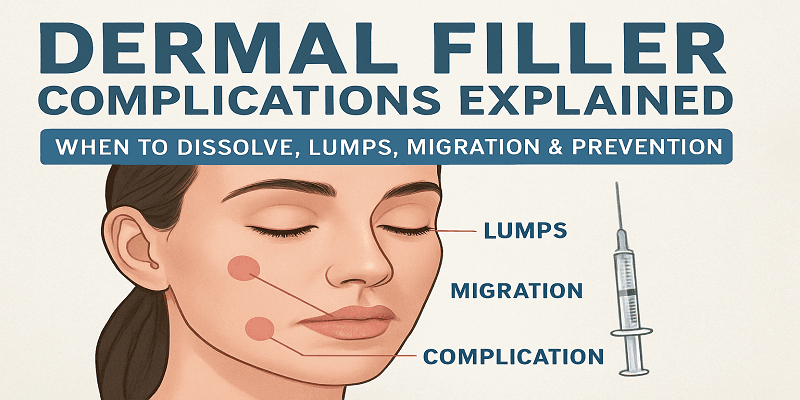
As we cross the 30s, the skin loses its collagen, elasticity, and volume, resulting in wrinkles, sunken cheeks, slurred jawlines, and withered lips, pointing out the aging process. Dermal fillers represent a non-surgical, popular method of revitalizing youthfulness as well as improving facial shape. They are fast, visible with minimal downtime, and are thus an attractive option to many.
Nevertheless, dermal fillers, like many cosmetic treatments, are not completely safe. Lumps, migration, overfilling, or even rare vascular problems can complicate the patients, leaving them confused or worried about their outcomes. It is necessary to understand how such complications occur and how to avoid complications to attain safe, natural, and accurate outcomes.
This blog not only points out the most frequent dermal filler complications, but also explains how to respond to them and seek medical help before it’s too late.
Dermal fillers are an injectable gel-like material, most commonly made of hyaluronic acid (HA), a natural sugar molecule that occurs in the skin and holds water, giving it a fuller look. The first FDA-approval of dermal filler treatment was in 2003 to treat moderate to severe wrinkles and folds on the face, and since the time has gone by, their usage has been extended to other parts of the face, including the body.
Dermal fillers rejuvenate the youthful appearance by filling out volume loss, deep lines, and improving natural facial features. Hyaluronic acid is regarded as one of the safest and most flexible to use in rejuvenating the face due to its biocompatibility and reversibility.
Although dermal fillers are fairly safe when injected by qualified physicians, the presence of complications always remains a possibility. Knowledge of the typical dermal filler complications helps one be aware of what is in the normal healing process and when to seek medical care.
Here are some complications that can happen after getting dermal fillers in Viera:
Swelling and bruising are minor side effects occurring among others. They are normally a result of needle or cannula penetration, tissue damage, and the body’s inflammatory response.
What’s normal:
When it becomes a concern:
This is common, especially on the lips and under the eyes, since the skin in these regions is thinner. These effects can be reduced with proper aftercare and cold compresses.
Derma lumps or nodules are one of the most common cases of dermal filler complications. Their characteristics can either be hard or soft to the skin and observable or just felt.
Usual causes of filler lumps are:
Types of lumps
Not every lump is permanent or even dangerous, and nodules that are persistent or painful always need a doctor. Cases may call for the dissolution of dermal fillers with hyaluronidase.
Why Lumps Can Form?
After filler injections, lumps may develop for several reasons:
When Lumps Are Not a Problem?
A large number of lumps are small and self-limiting, that is, they spontaneously clear away. Symptoms that a lump is probably harmless include:
When Lumps Need Professional Help?
Some lumps must be assessed immediately.
The intervention might be required in such instances, and it can be a specific massage or filler dissolution with hyaluronidase. Overlooking lumps that do not go away may result in a permanent aesthetic complication or pain.
Filler Migration is experienced when the filler product migrates out of the initial treatment zone. This might distort the face and make it look strange in the long run. Popular places of migration are observed:
The causes of filler migration are:
Vascular complications are the most severe dermal filler risks, but their occurrence is uncommon. These are experienced when filler accidentally gets into or squeezes a blood vessel and limits the blood flow. Complications may include:
Although dermal fillers are supposed to be long-lasting, sometimes it is important to have them dissolved. The most commonly used enzyme to dissolve hyaluronic acid fillers is hyaluronidase. Knowledge of possible filler dissolution time and reason can avoid long-term discontent and complications.
Dermal fillers can either be dissolved on medical or cosmetic grounds.
Medical reasons include:
Aesthetic reasons include:
In the case of dermal fillers, prevention is always better than cure. Although there are complications that may arise even in the most experienced hands, proper planning, technique, and aftercare play a very crucial role in mitigating risks. Here are some guidelines you must follow to avoid complications:
The choice of a trained and certified injector is one of the most significant ones when it comes to the prevention of complications:
Non-medical practitioners or uncertified practitioners should be avoided since the use of the wrong method contributes to the appearance of lumps, migration, and even vascular problems.
Not every filler is made the same way. It is imperative to use the appropriate filler in a particular area to ensure natural outcomes and diminish the complications:
The filler type, viscosity, and depth of injection should be selected by your injector according to the facial anatomy and desired treatment results.
Most complications are caused by overfilling or aggressive treatment. The philosophy of less is more can avoid the unwanted consequences:
Here are the cases when urgent action is necessary:
Although the symptoms may not put a person at risk of death, certain aspects need to be considered:
Concerned about wrinkles, sinking skin, or asymmetrical dermal fillers? At Enfield Royal Med Spa Viera, we are all about safe and natural facial rejuvenation. Our highly trained injectors offer intimate therapies with continuous observation and follow-up clinic visits to avoid complications such as lumps, migration, or overfilling.
Schedule your dermal filler appointment and feel good about your fillers.
Let Us Know Where to Send Your Code
Valid once per new client. Expires in 30 day